
Planning, Time and the Cost of Capital: Why Article 45 Matters for Phu Quoc Investors
Article 45 may matter less because it creates a new planning label, and more because it changes the sequence, integration and potential timing of planning decisions inside a Special Economic Zone.

Tax incentives are easy to see.
A lower rate can be placed in a presentation.
An exemption can be modelled in a spreadsheet.
Waiting is different.
Waiting often appears nowhere in the investment brochure, yet it can affect the value of the entire future cash-flow stream.
For a long-term investor, the real planning question is not simply “What can I build?” It is also “When can I know, with sufficient certainty, what I can build?”
This is why Article 45 of Vietnam’s Urban Development Law No. 18/2026/QH16 deserves close attention.
It does not promise that every project will be approved faster. It does not create automatic land conversion. And it does not remove the need to comply with land, environmental, construction or investment law.
What it does is change the planning architecture for a Special Economic Zone.
For investors, that may be economically important.
What Article 45 actually says
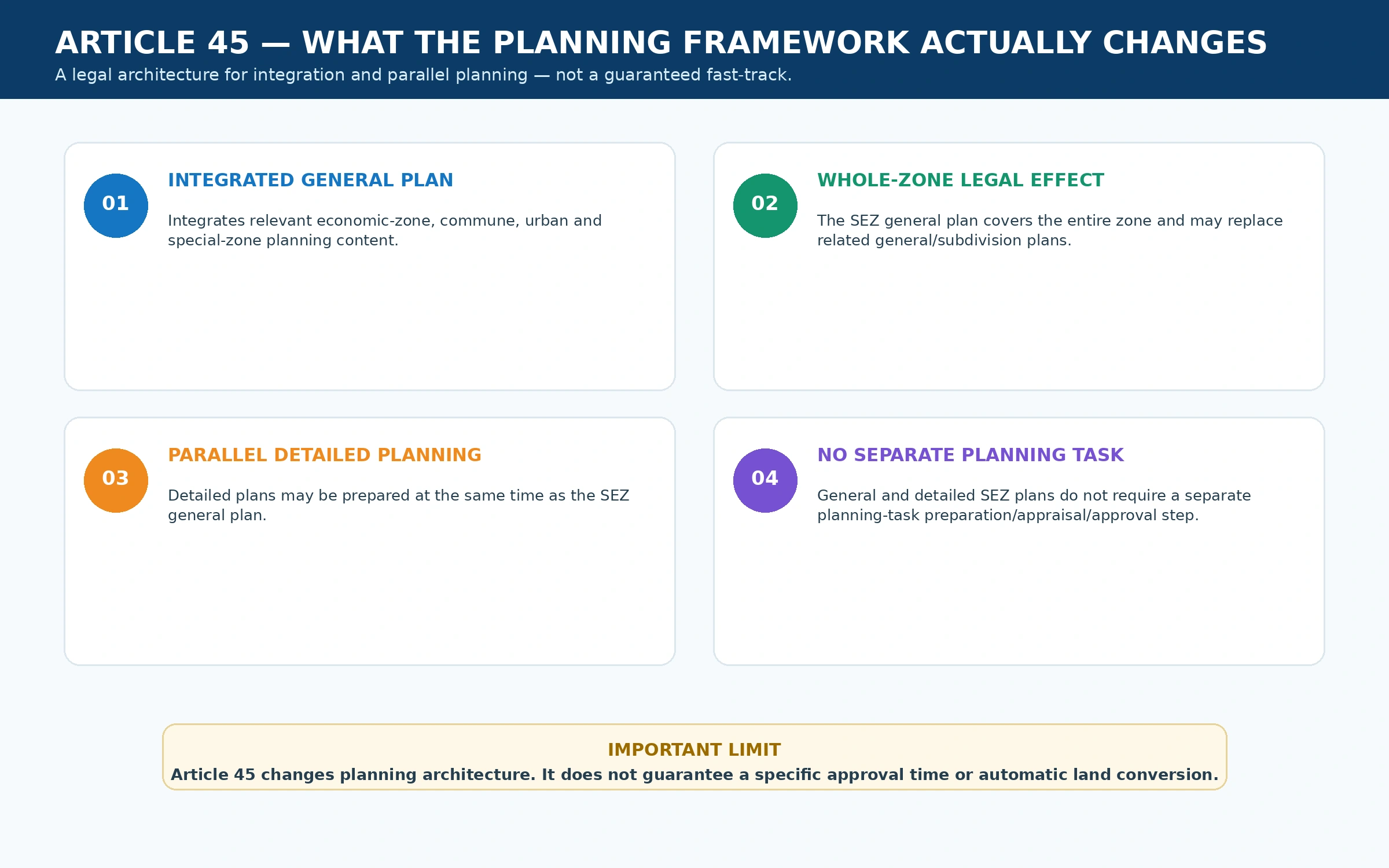
Article 45 establishes a specific planning framework for a Special Economic Zone.
The general plan is prepared for the entire SEZ and integrates relevant content from existing economic-zone, commune, urban and special-zone planning frameworks.
The law also provides that the SEZ general plan is intended to concretise higher-level national, regional and provincial planning, while replacing and having legal value equivalent to related general and subdivision plans within the SEZ.
Importantly, the content of the SEZ general plan may differ from the provincial plan where required to meet national and SEZ development objectives; the provincial plan is adjusted after the SEZ general plan is approved.
Detailed planning is then prepared for individual areas within the SEZ.
But Article 45 contains two provisions that are particularly relevant to investors:
Detailed planning may be prepared at the same time as the SEZ general plan.
And:
SEZ general and detailed planning do not require the separate preparation, appraisal and approval of a planning task.
The most important word may be “simultaneously”
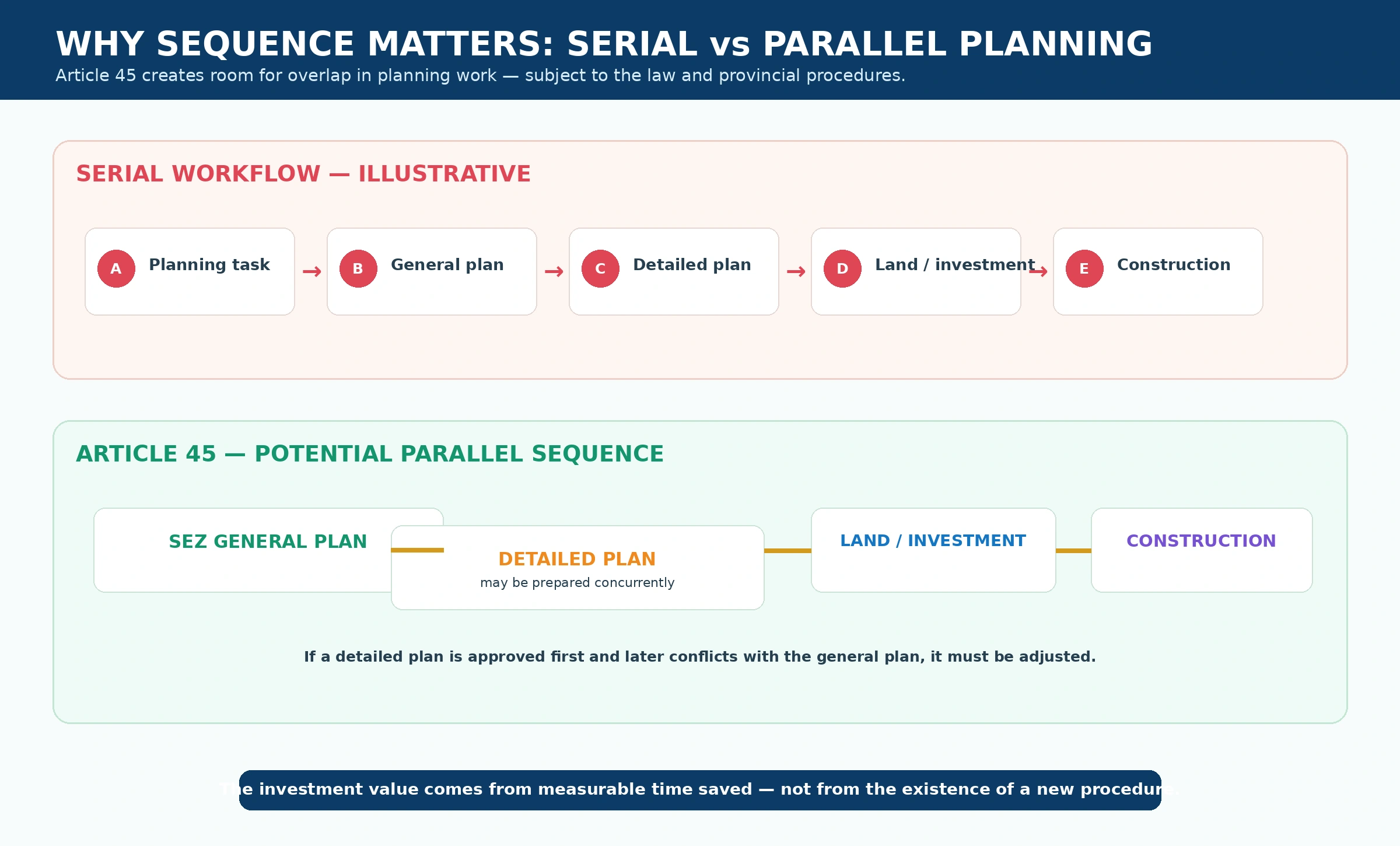
Large projects lose time when each stage must wait for the previous stage to be completely finished before the next stage can begin.
In project management, this is the difference between a purely serial process and a process where selected workstreams can proceed in parallel.
Article 45 expressly allows detailed planning inside the SEZ to be organised at the same time as the general plan.
If a detailed plan has completed preparation and appraisal before the SEZ general plan, the law permits it to be approved first.
There is an important safeguard: if that detailed plan later conflicts with the approved general plan, it must be adjusted to ensure consistency.
This distinction matters.
The law is not saying:
“Skip planning.”
It is saying that certain planning work does not necessarily have to occur in a completely sequential order.
For an investor, that creates a possibility:
planning work can move closer to the speed of capital — provided implementation is disciplined and decisions remain legally consistent.
Why time affects valuation
A project is generally valued from future cash flows.
Future cash flows are worth less than cash flows received earlier because investors apply a discount rate reflecting the time value of money and risk.
A simplified relationship is:
Present Value after delay = Present Value today ÷ (1 + discount rate)years delayed
This creates a very useful way to think about regulatory time.
If all future cash flows of a project are delayed by one year and the relevant discount rate is 10%, the present value of those cash flows is approximately 9.1% lower, assuming the operating cash-flow profile is otherwise unchanged.
A two-year delay reduces present value by approximately 17.4% under the same simplified assumption.
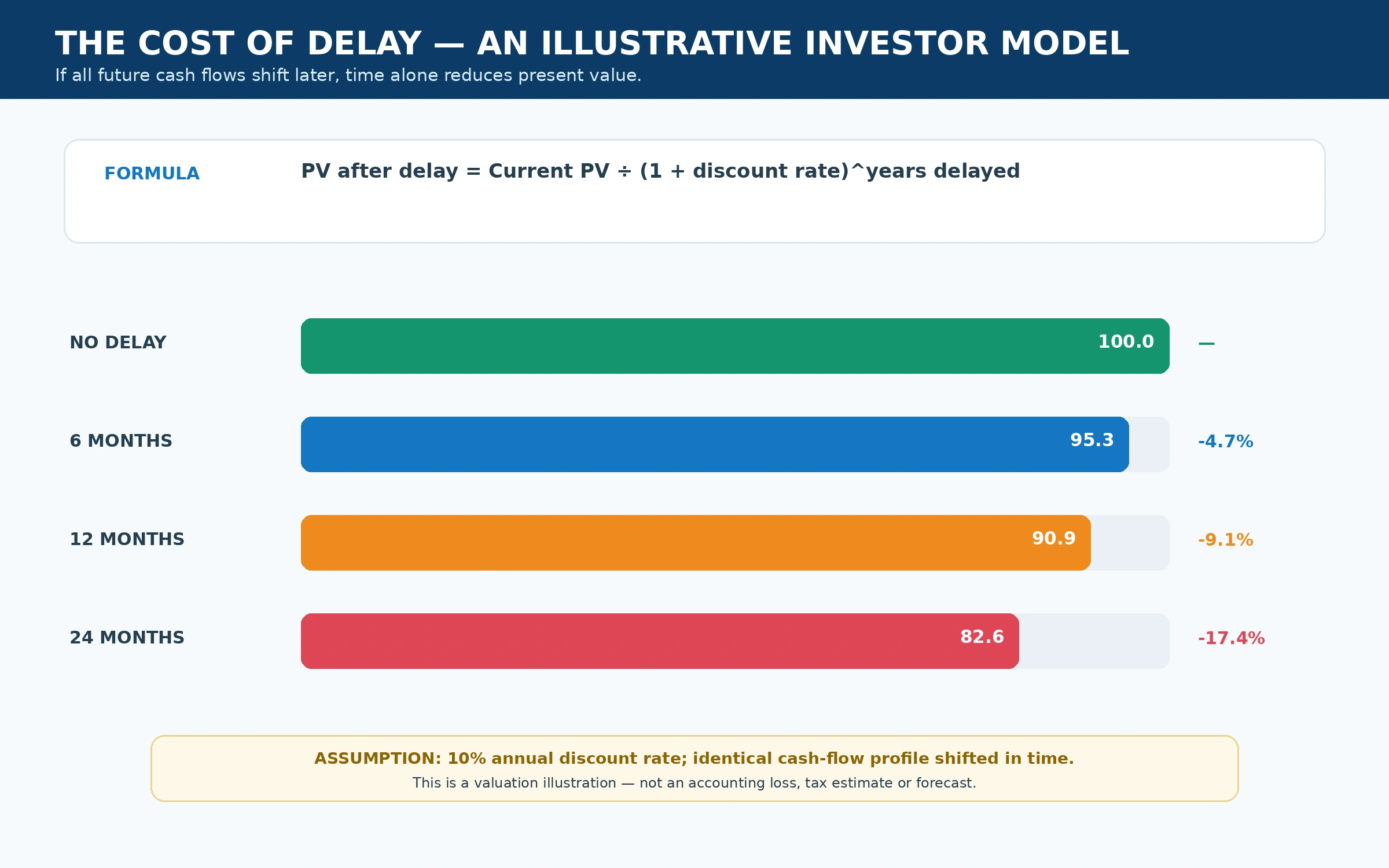
This is not an accounting loss.
It is not a forecast.
And a real project has a much more complex drawdown schedule.
But it shows why investors care about timing.
Why time can sometimes be worth more than an incentive
A tax incentive usually applies to a particular part of the project economics — for example taxable profit during a defined period.
A delay can affect the timing of the entire project.
That means slower execution can create costs through several channels at the same time:
1. Capital carrying cost.
Equity and debt may already be committed while the asset is not yet generating revenue.
2. Deferred operating cash flow.
Hotels, retail, logistics or other operating assets begin producing revenue later.
3. Market-window risk.
A project designed for a specific demand cycle can miss the period when that demand is strongest.
4. Higher uncertainty discount.
If the investor cannot estimate when a decision will arrive, the required return may rise.
This is why the headline question:
“What tax rate do I receive?”
should often be accompanied by:
“What is my time to certainty, time to construction and time to revenue?”
Planning certainty is different from planning flexibility
Investors often use the word “flexibility” positively.
But too much ambiguity is not flexibility.
It is uncertainty.
A professional capital market needs rules that are sufficiently adaptable to support development but sufficiently clear for investors to model.
For Phu Quoc, the ideal outcome is not a planning system where almost anything can be negotiated.
It is a system where:
permitted functions are clear;
prohibited functions are clear;
the responsible authority is clear;
required documents are clear;
the sequence is clear;
and decision time becomes increasingly measurable.
Certainty can be more valuable than informality because certainty can be priced.
Article 45 could also destroy some speculative value
This is an important point for real-estate investors.
More planning clarity does not necessarily make every property more valuable.
It can do the opposite.
When planning is unclear, a piece of land can carry multiple speculative narratives:
future residential conversion;
future commercial use;
a future road;
a future project;
or a future urban expansion area.
Once the planning framework becomes clearer, some of those stories may be confirmed.
Others may disappear.
So better planning can produce two effects simultaneously:
certainty premium for assets aligned with future economic use;
and
expectation discount for assets whose speculative thesis is not supported.
That is not a weakness of the system.
It is one of the ways a market becomes more mature.
The primary legal text matters
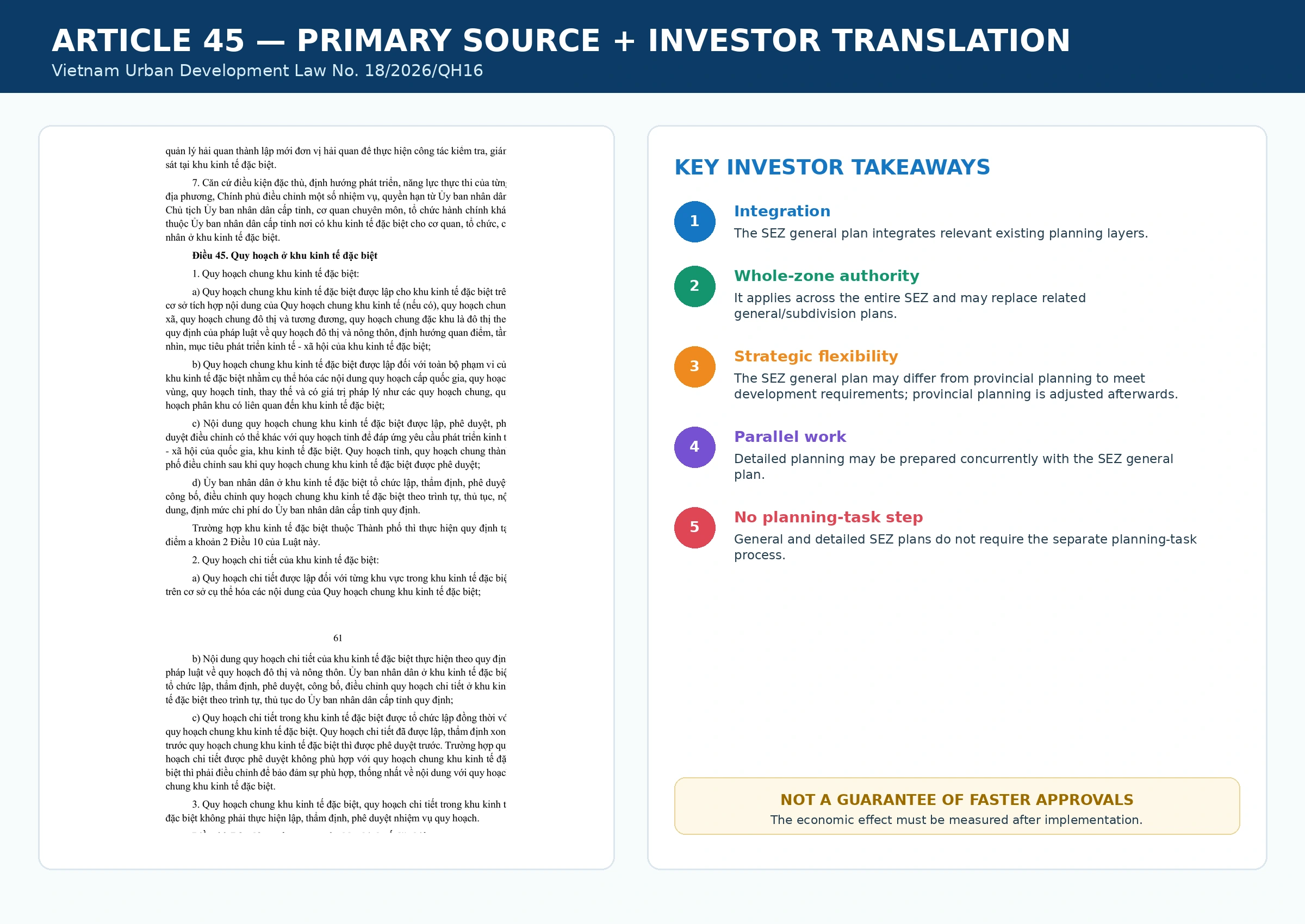
The primary text is especially important because Article 45 does not state that planning will be completed within a specific number of days.
Any claim that the law “cuts planning from X years to Y months” would therefore go beyond what Article 45 itself says.
The economic benefit has to be demonstrated after implementation.
Three scenarios for Article 45 implementation
| Scenario | What happens | Investor interpretation |
|---|---|---|
| Execution upside | Planning layers are genuinely integrated, selected work proceeds in parallel and decision times become measurable. | Lower time-to-certainty and potentially lower regulatory risk premium. |
| Base case | Planning clarity improves, but bottlenecks shift to land, environmental or investment procedures. | Positive, but the total time-to-revenue improvement is moderate. |
| Execution downside | New planning architecture exists on paper but coordination remains slow or frequently revised. | Limited economic advantage despite the legal reform. |
This is why PhuQuocHome will not judge Article 45 simply by whether a new plan is approved.
We will judge it by what happens to the investment clock.
The five planning KPIs we would track
Planning Time — how long does it take to reach usable planning certainty?
Decision Time — how long does it take to receive a clear yes, no or revision request?
Revision Rate — how often do approved or nearly approved plans require material adjustment?
Time to Construction — how long from investment decision to physical execution?
Time to Revenue — how long until the asset begins producing operating revenue?
The last KPI is the one that matters most to capital.
Why this could matter particularly in Phu Quoc
Phu Quoc is not a blank site.
It already contains tourism zones, urban areas, existing projects, infrastructure corridors, environmental constraints and multiple planning layers created over time.
A framework capable of integrating those layers has greater potential value here than it would in a completely undeveloped location.
But integration is only valuable if it reduces contradiction.
Parallel processing is only valuable if it reduces time without increasing rework.
Local authority is only valuable if decisions become clearer and more predictable.
That is the standard investors should apply.
The biggest mistake would be to treat Article 45 as a land-price story
The immediate market temptation is obvious:
new planning mechanism → more development → higher land prices.
That chain is too simplistic.
The more defensible chain is:
better planning architecture → greater certainty → faster capital deployment → more operating assets → more employment and demand → potential changes in asset value.
There are several steps between law and valuation.
Every one of them must work.
What we will watch after the law takes effect
Law No. 18/2026/QH16 takes effect on 1 October 2026, subject to the specific exceptions stated in its implementation provisions.
For Article 45, the important questions will be practical:
How does the provincial authority define the planning procedures?
How quickly is an SEZ general plan organised once the legal conditions exist?
Which detailed plans are prepared concurrently?
How frequently do early detailed plans require later adjustment?
Do downstream land and environmental procedures move faster as planning becomes clearer?
These questions will tell investors much more than the existence of Article 45 alone.
Conclusion: the highest-value asset Article 45 could create is certainty
A Special Economic Zone can offer tax incentives.
It can attract strategic investors.
It can support duty-free trade.
It can create new institutional powers.
But capital still moves through time.
The investor who knows a project will take twelve months can model twelve months. The investor who is told “maybe six months, maybe three years” has to price uncertainty itself.
That is why Article 45 deserves attention.
Not because it guarantees faster planning.
It does not.
But because it creates a legal structure in which integration and parallel planning may reduce one of the least visible costs in development:
the cost of waiting.
If Phu Quoc eventually operates under this framework and planning time becomes measurably shorter and more predictable, the economic benefit may extend far beyond administration.
It could affect capital allocation, project valuation, investment competition and ultimately the speed at which infrastructure becomes a functioning economy.
Primary legal source: Article 45, Vietnam Urban Development Law No. 18/2026/QH16. The article provides for an integrated SEZ general plan, whole-zone legal effect, concurrent preparation of detailed planning and removal of the separate planning-task step. Law source: Law No. 18/2026/QH16.
Effective date: the Law takes effect on 1 October 2026, except for provisions specifically stated otherwise.
Financial model: the cost-of-delay chart applies a 10% annual discount rate to an unchanged future cash-flow profile shifted later in time. It is an illustrative valuation model, not an official forecast, accounting loss or tax calculation.
Concepts including Time to Certainty, Time to Revenue, Certainty Premium and Expectation Discount are PhuQuocHome investment-research frameworks.