
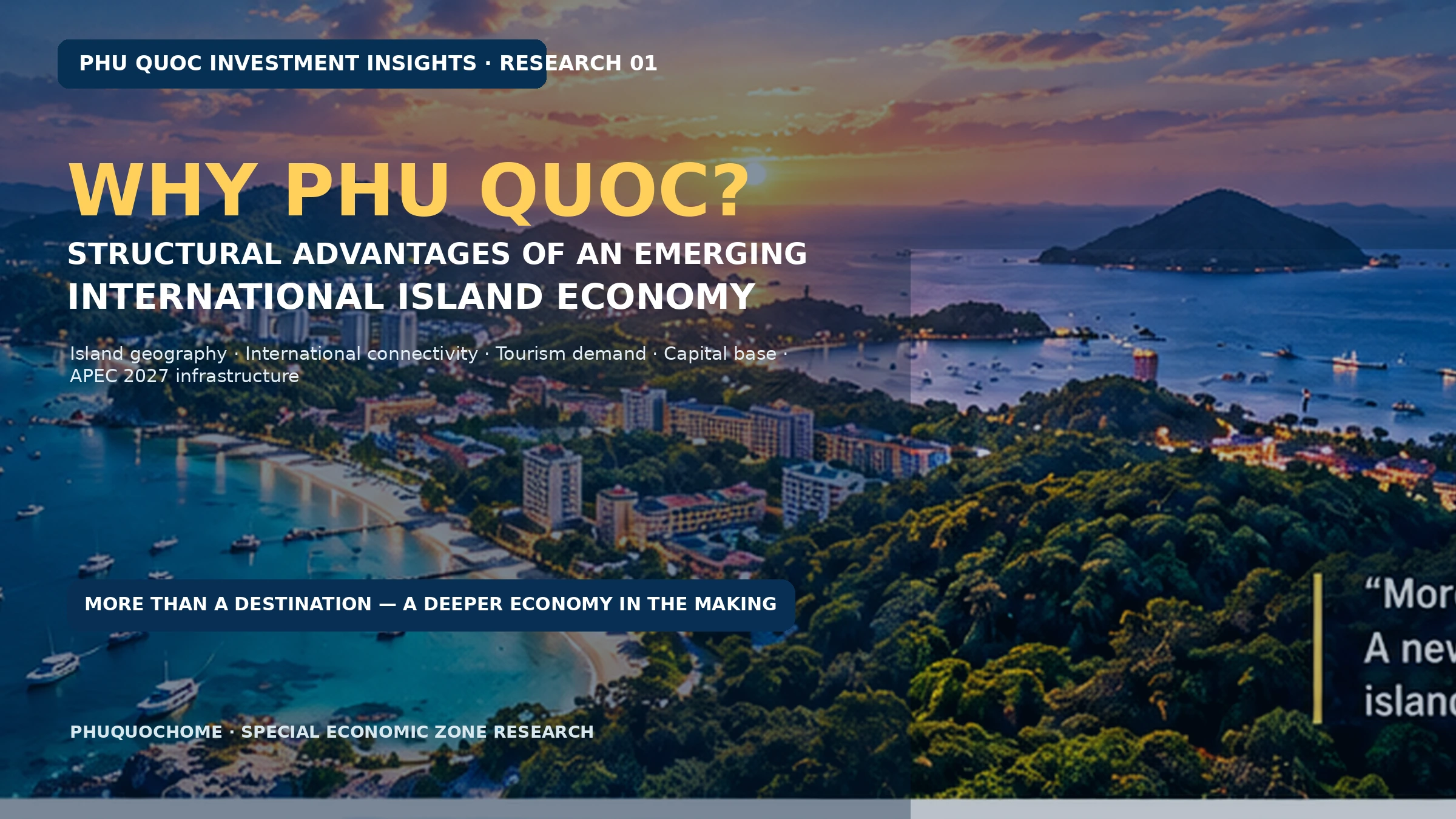
Why Phu Quoc? Structural Advantages of an Emerging International Island Economy
Why Phu Quoc may be uniquely positioned for Vietnam’s Special Economic Zone framework: island geography, international connectivity, tourism demand, infrastructure, capital and APEC 2027.
A new airport can be built.
Roads can be widened.
Tax incentives can be introduced.
Hotels can be developed.
But some economic advantages cannot be manufactured quickly.
Geography is one of them.
Phu Quoc is an island with relatively clear physical boundaries, an operating international airport, a globally recognised tourism economy and an already substantial investment base.
Vietnam is now adding another variable: a new legal framework for Special Economic Zones under Law No. 18/2026/QH16.
That combination is what makes Phu Quoc worth examining. Not because a new legal label automatically creates investment value. It does not.
Does Phu Quoc already possess enough structural advantages for a Special Economic Zone framework to accelerate an economy that is already functioning?
That is a much more interesting investment question.
Phu Quoc would not be starting from zero
Many development zones begin with an idea. A location is selected. Infrastructure is planned. Investors are then asked to imagine what the location might become in ten or twenty years.
Phu Quoc is different. The island already has a substantial operating economy.
In 2025, Phu Quoc received approximately 8.3 million visitors, up 38.51% year on year. International arrivals reached approximately 1.86 million, up 93.62%.
Tourism and services currently account for around 70% of Phu Quoc’s production value structure and approximately 70% of employment on the island.
This matters. A potential Special Economic Zone would therefore not be trying to create demand from nothing. It would be trying to upgrade an existing demand base.
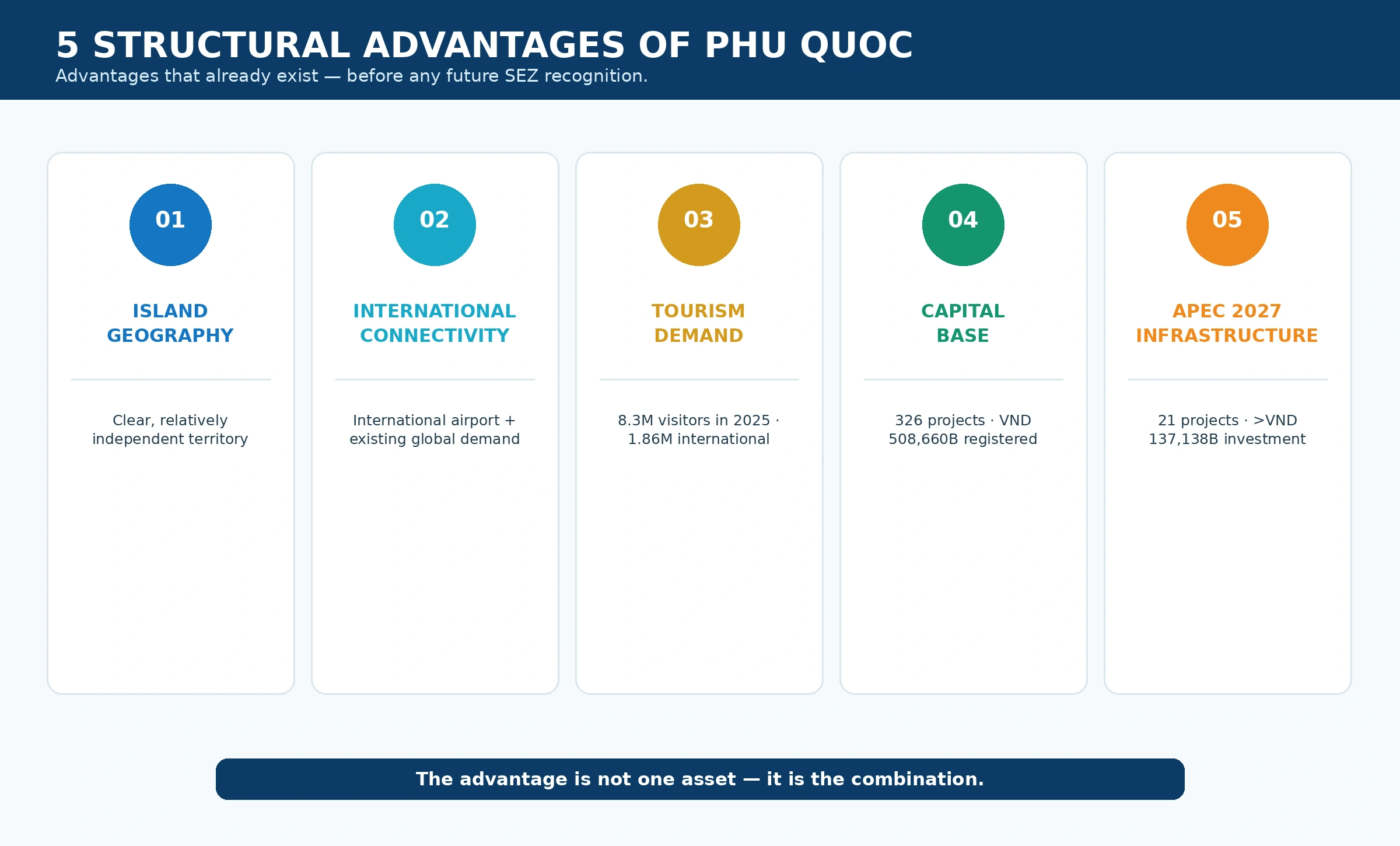
Structural Advantage 1: Island geography
Article 43 of Vietnam’s 2026 Urban Development Law identifies several criteria for recognition as a Special Economic Zone. Among them are a strategic location, an international airport or Class I-or-higher seaport, and a relatively independent, controllable territory with sufficient population and natural area.
Phu Quoc’s island geography is therefore more than a tourism asset. It is also an economic-design advantage.
An island offers relatively clear boundaries for customs administration, transport management, tourism flows, environmental monitoring, land-use planning and potentially differentiated economic policies.
For an investor, this can matter because Special Economic Zones work best when the jurisdiction is understandable: where does the zone begin, which authority is responsible, which regulations apply, and how do people and goods enter and leave?
But geography alone is not enough. The same island structure that makes Phu Quoc easier to define also creates hard constraints: water, energy, waste treatment, transport capacity and environmental carrying capacity.
So island geography is both an advantage and a discipline.
Structural Advantage 2: International connectivity already exists
One of the most difficult components of an island economy is connectivity.
Without sufficient air or sea access, almost every other economic strategy becomes harder. Talent is harder to attract. Tourism is harder to scale. High-value services are harder to operate. Business travel becomes inconvenient. Supply chains become more expensive.
Phu Quoc already operates an international airport. More importantly, international demand is no longer theoretical.
The island received approximately 1.86 million international visitors in 2025.
The next question is not: Can we build an airport?
Can airport connectivity be converted into a broader economic network?
That means moving beyond passenger traffic toward aviation services, MICE, trade, high-value tourism, international education, healthcare, long-stay residence, business services and other cross-border activities.
Structural Advantage 3: APEC 2027 is compressing years of infrastructure investment
APEC 2027 may prove important for Phu Quoc for a reason that has little to do with the event itself. It is accelerating infrastructure.
Official information states that 21 projects are being implemented on the island in preparation for APEC 2027, with combined investment exceeding VND 137.138 trillion.
These projects include transport, airport expansion, water, environmental systems, urban infrastructure and facilities associated with the summit.
For a long-term investor, the event date is not the most important date. The more interesting period begins after it.
2028.
Did APEC build event infrastructure, or economic infrastructure?
If new capacity continues to support more international routes, business events, higher visitor spending, new residents, new businesses and greater capital deployment, then APEC will have created a legacy economy.
If usage drops sharply after the event, the investment impact will be much narrower.
Structural Advantage 4: Capital is already present
Another feature that separates Phu Quoc from many emerging zones is the size of its existing investment pipeline.
As of June 2026, the Phu Quoc Economic Zone had 326 investment projects in force, covering more than 10,549 hectares, with total registered investment capital of approximately VND 508.660 trillion.
Approximately VND 31.603 trillion was disbursed during the first six months of 2026. Official reporting indicates that 58 projects were already operating at that point.
These figures are significant. But they also expose one of the most important issues facing Phu Quoc.
The island does not simply need more registered capital. It needs a higher CAPITAL CONVERSION RATE.
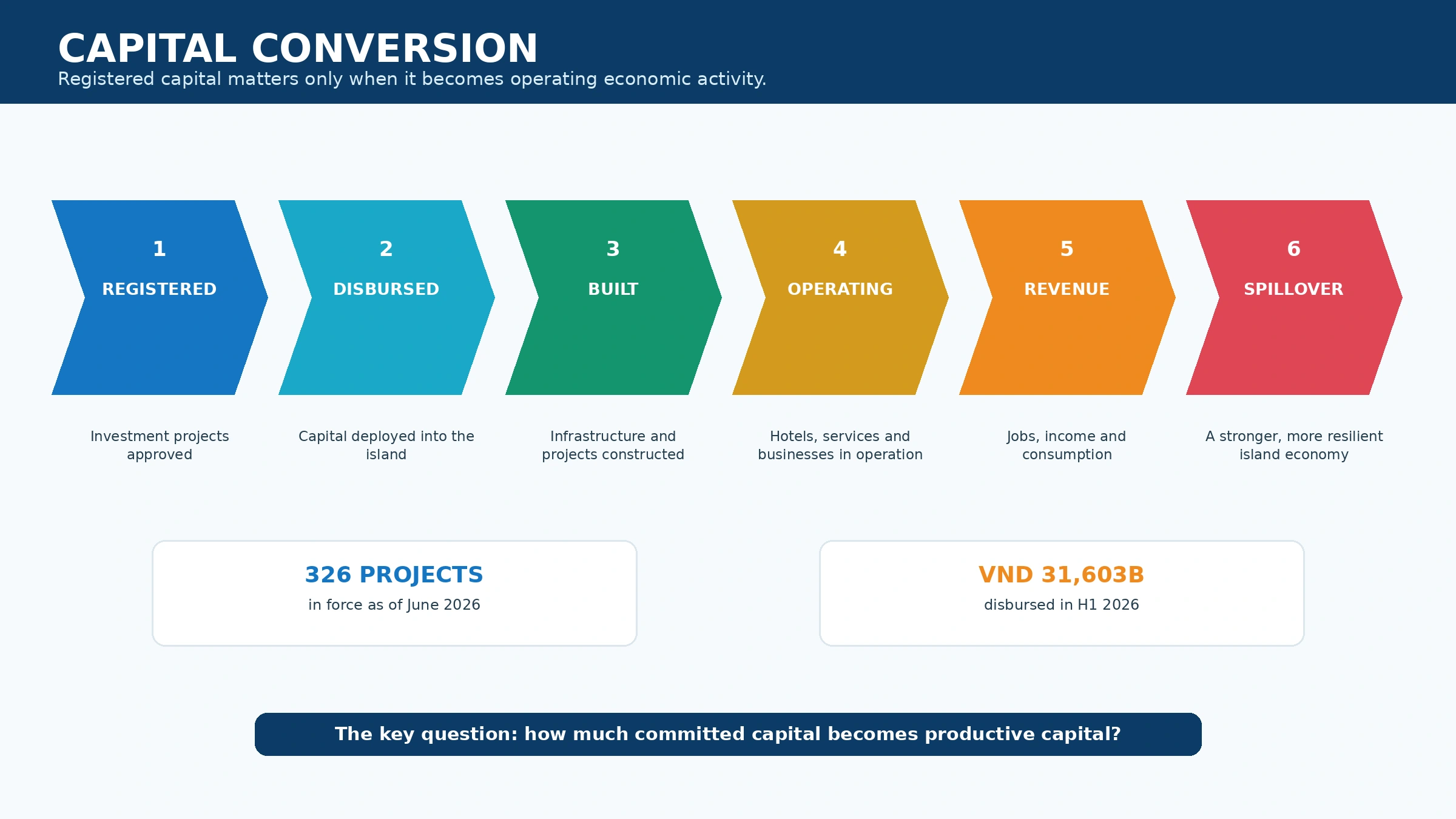
That means converting registered capital → disbursement → construction → operating assets → employment → revenue → economic spillovers.
An island with VND 600 trillion of announced projects is not necessarily stronger than an island with VND 400 trillion of projects that actually operate.
This is why our research consistently separates investment announcements from investment realisation.
Structural Advantage 5: Phu Quoc already has global consumer demand
Phu Quoc already has millions of consumers physically arriving on the island every year. That matters for much more than hotels.
A visitor represents potential demand for retail, restaurants, transport, entertainment, wellness, healthcare, marina services, events, financial services and other forms of consumption.
The problem is that visitor volume alone does not tell us whether this demand is being monetised efficiently.
Two islands can each receive ten million visitors and produce very different economic outcomes.
The important variables are: how long do they stay, how much do they spend, what do they spend on, and how much of that spending stays in the local economy?
This is why we prefer SPEND PER VISITOR rather than simply VISITOR COUNT.
The legal framework fits several characteristics Phu Quoc already possesses
The new law introduces a specific framework for Special Economic Zones. Article 43 requires strategic location, international airport or qualifying seaport access, and a relatively independent and controllable territory.
Phu Quoc clearly has characteristics that make the discussion relevant. But there is an important legal distinction.
Meeting or appearing to meet criteria does not automatically make a location a Special Economic Zone.
Article 43 states that the Government recognises a Special Economic Zone after approval in principle by the competent authority.
The law takes effect on 1 October 2026, while certain tax provisions apply from the 2027 tax period.
Phu Quoc should not yet be presented as a formally recognised Special Economic Zone under Law No. 18/2026/QH16.
Serious investors should separate legal framework from legal recognition and then from actual implementation. These are three different stages.
Why this matters to an investor
Suppose two islands offer similar beaches, hotels and air connectivity.
One has uncertain planning, fragmented approvals, limited infrastructure capacity and a narrow tourism economy.
The other has clearer planning, faster decisions, higher infrastructure capacity, stronger international connectivity, diversified businesses and recurring resident demand.
Over time, the second island deserves a different valuation. Not because it is called “special”. But because it converts capital into economic activity more efficiently.
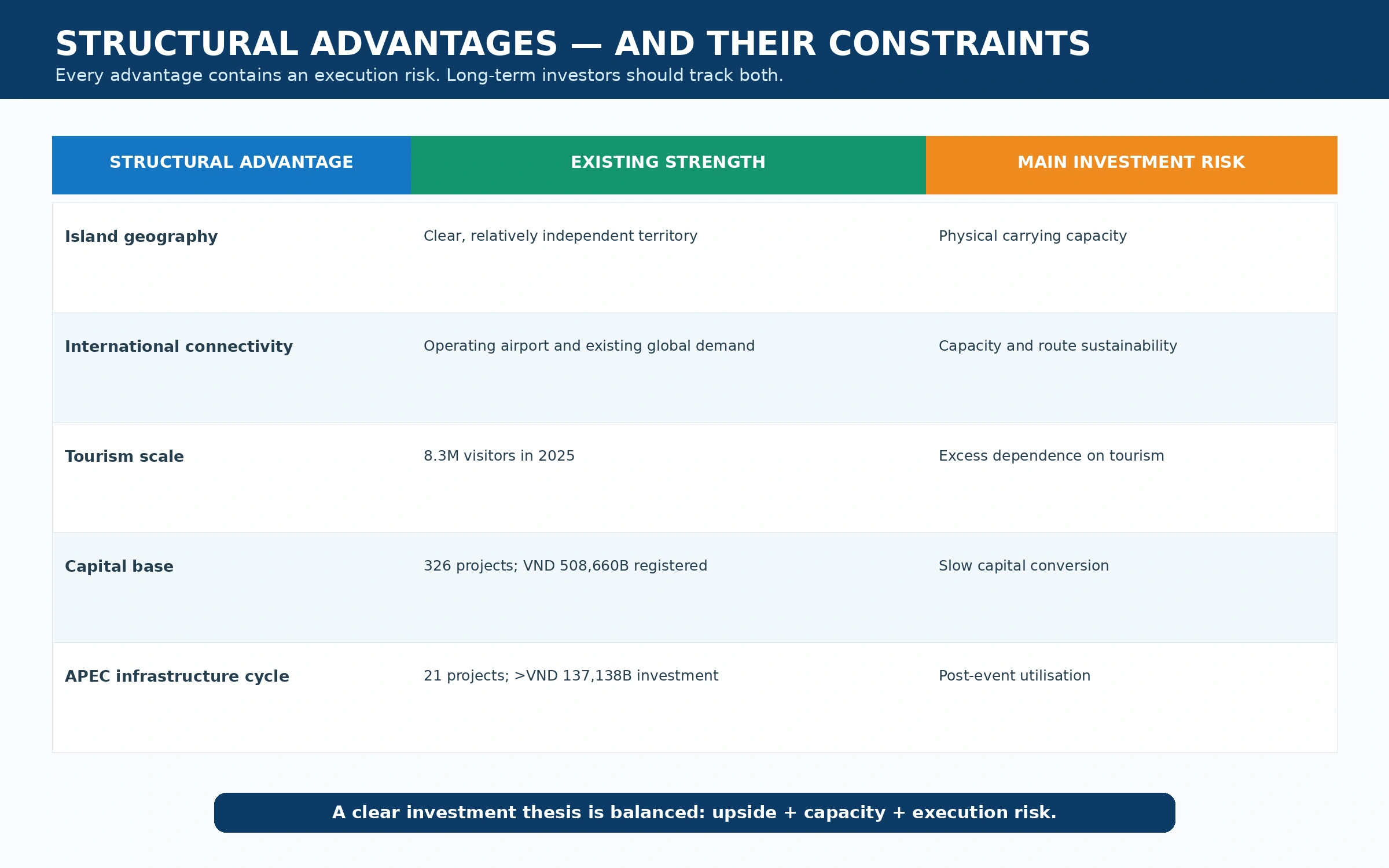
The five structural advantages — and what could prevent them from working
| Structural advantage | Existing strength | Main investment risk |
|---|---|---|
| Island geography | Clear, relatively independent territory | Physical carrying capacity |
| International connectivity | Existing airport and international demand | Capacity and route sustainability |
| Tourism scale | 8.3M visitors in 2025 | Excess dependence on tourism |
| Capital base | 326 active projects; VND 508,660B registered | Slow capital conversion |
| APEC infrastructure cycle | 21 major projects; >VND 137,138B | Post-event utilisation |
Phu Quoc’s biggest strength may also be its biggest weakness
Tourism and services currently represent roughly 70% of Phu Quoc’s economic structure.
That is evidence of success. But it is also concentration risk.
A mature island economy cannot depend indefinitely on hotel occupancy, airfare, seasonality and leisure demand.
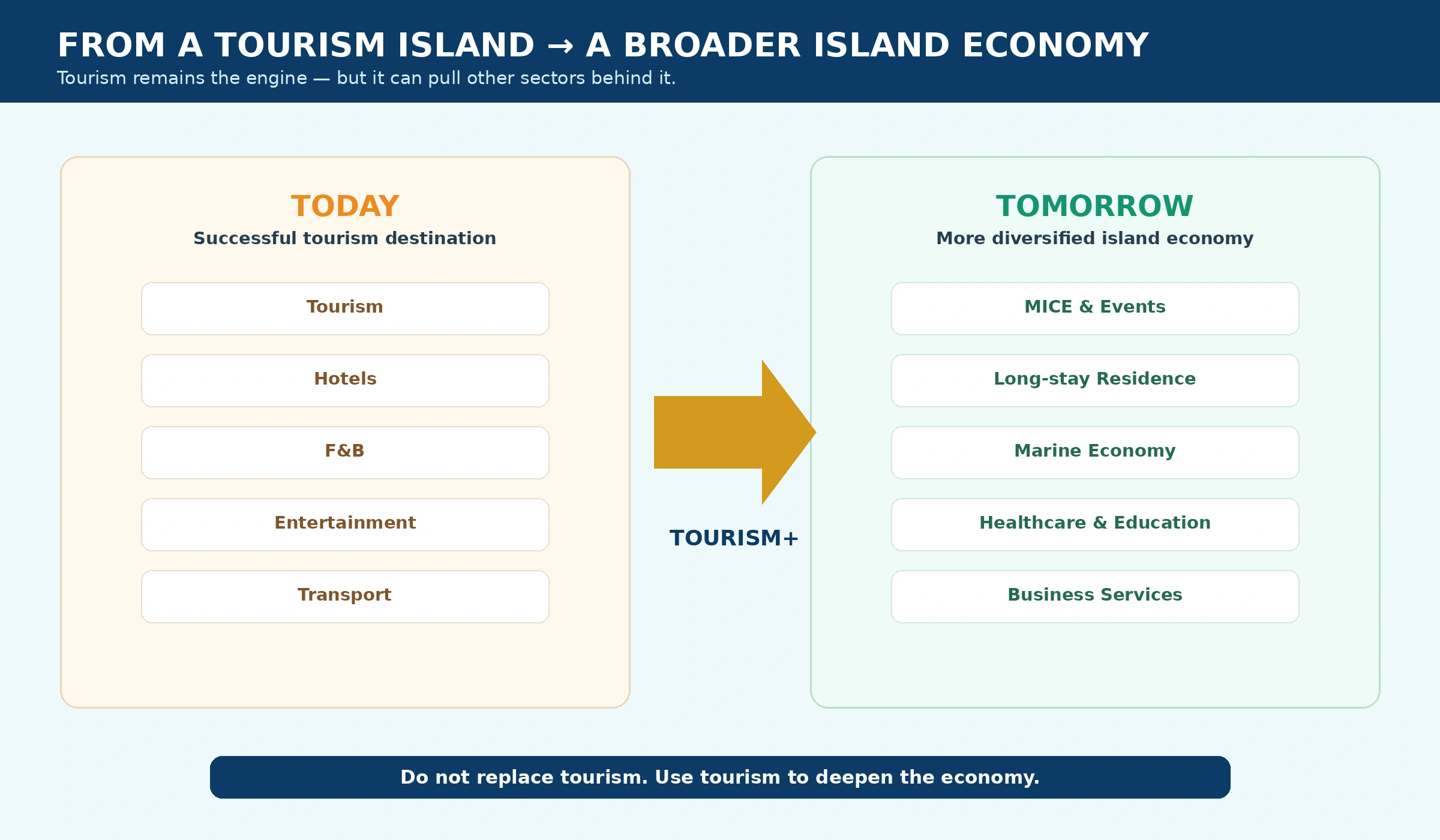
A future development model must create additional layers: international business services, marine economy, education, healthcare, retail, MICE, long-stay residence, logistics, aviation services and technology-enabled tourism services.
This does not mean Phu Quoc should move away from tourism. Tourism should remain the engine.
The opportunity is to use that engine to pull other sectors behind it.
TOURISM+
The island should not compete to become a smaller version of somewhere else
It is tempting to compare Phu Quoc with Hainan, Jeju, Batam, Dubai or Singapore. The comparisons can be useful. But copying any one model would be a mistake.
Hainan has an enormous domestic Chinese market. Batam sits next to Singapore and has deep industrial and logistics links. Jeju operates within a very different Korean institutional and consumer environment.
Phu Quoc has its own combination: Vietnamese growth, Southeast Asian geography, international tourism, island economics, resort infrastructure and a rapidly evolving legal framework.
Use lessons from multiple successful zones to build a model that fits Phu Quoc’s own constraints and advantages.
What would make us more bullish on Phu Quoc?
The thesis becomes materially stronger if several things happen together: formal SEZ recognition and clear implementing rules; faster planning and investment decisions; continued international connectivity growth; higher capital conversion; credible anchor investors in sectors beyond conventional tourism; higher spend per visitor and length of stay; a measurable long-stay resident population; and infrastructure capacity keeping pace with demand.
What would make us more cautious?
The opposite signals would weaken the thesis: rapid land-price appreciation without rental growth; new hotels without sufficient demand; retail construction without real spending; registered projects without disbursement; large infrastructure without post-event utilisation; or persistent constraints in water, wastewater, energy and transport.
These would suggest that asset values are moving faster than the underlying economy.
The real Phu Quoc opportunity
The easiest way to describe Phu Quoc is a successful tropical tourism island. But that description may become increasingly incomplete.
The more interesting possibility is an international island economy built on top of an already successful destination.
A tourism island monetises visitors.
An island economy monetises visitors, residents, businesses, capital, trade, services and infrastructure.
Conclusion: Phu Quoc’s advantage is not one asset — it is the combination
There is no single reason to be constructive on Phu Quoc. That is precisely why the investment case is interesting.
It already has international demand, an international airport, a large tourism economy, significant investment capital, a major infrastructure cycle, island geography and a new national legal framework that may become relevant to its next phase of development.
Individually, none of these guarantees success. Together, they create something more valuable: optionality.
If the new framework is applied, can Phu Quoc convert advantages it already possesses into a deeper economic system faster than competing destinations?
That is what we will continue to measure. And that is why Phu Quoc deserves serious investor attention.
Legal analysis: Vietnam Urban Development Law No. 18/2026/QH16, particularly Article 43 governing Special Economic Zone recognition. Law No. 18/2026/QH16.
Tourism and economic-structure data: official Phu Quoc local-government reporting. Investment data: Phu Quoc Economic Zone Authority. APEC 2027 infrastructure data: official Phu Quoc sources.
Concepts including Capital Conversion, Spend per Visitor, Tourism+ and structural-advantage analysis are PhuQuocHome investment-research frameworks, not official forecasts.