
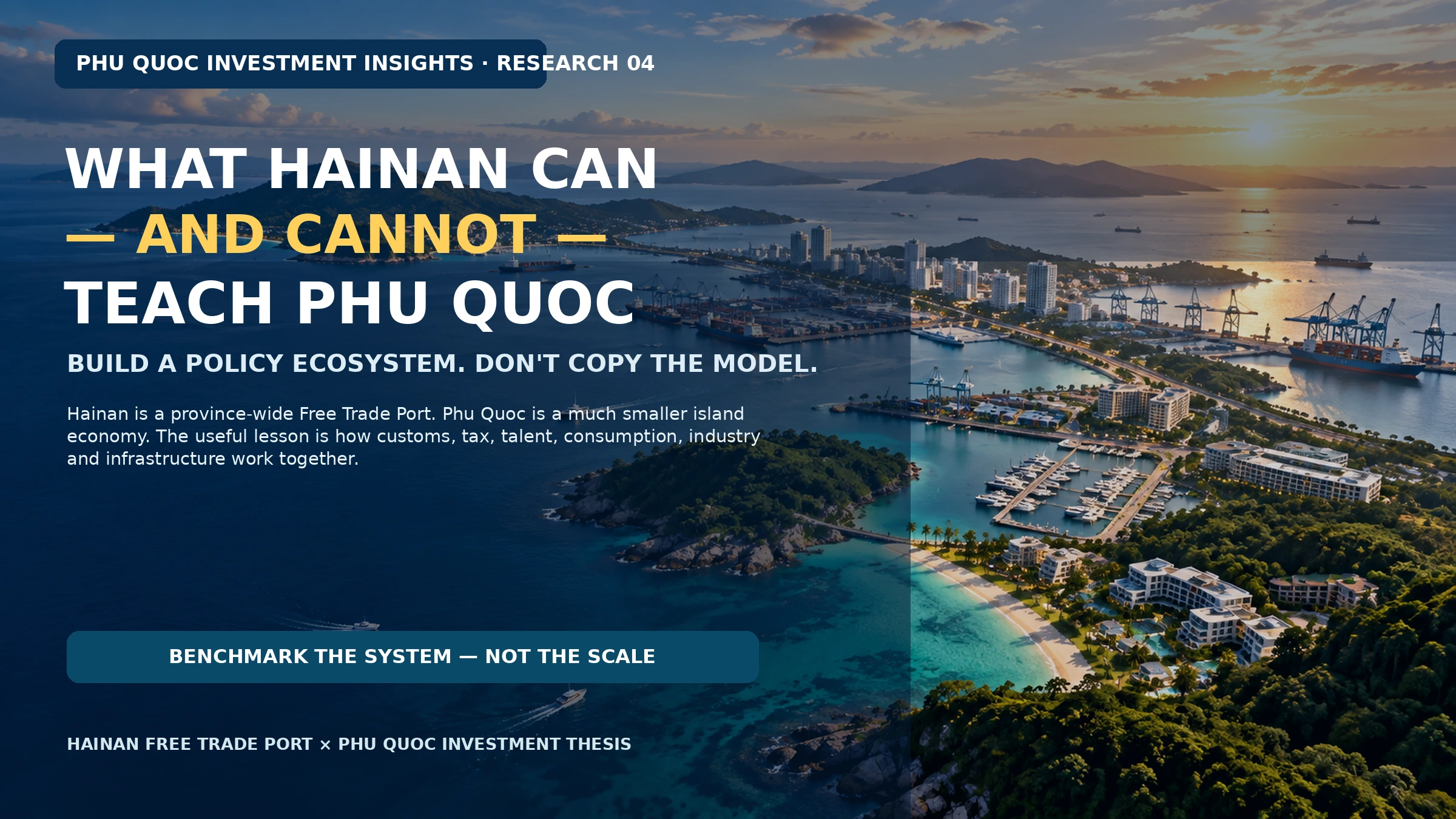
What Hainan Can — and Cannot — Teach Phu Quoc: Build a Policy Ecosystem, Not a Copy
Hainan matters to Phu Quoc not because the two islands are the same, but because Hainan shows what happens when customs, tax, talent, consumption, industry and infrastructure are designed as one system.
Comparisons between Phu Quoc and Hainan are almost inevitable.
Both are islands.
Both use tourism as an important economic engine.
Both are discussed in the context of special economic policy.
But the comparison can become misleading very quickly.
Hainan is not simply a “successful Special Economic Zone” that Phu Quoc can copy.
It is a province-wide Free Trade Port operating inside the institutional, customs and consumer-market architecture of China.
Phu Quoc is much smaller, has a very different population base, a different legal system and no comparable domestic market of more than a billion consumers behind it.
The useful question is not: “How can Phu Quoc become Hainan?” It is: “Which design principles in Hainan are transferable to a smaller international island economy?”
That distinction matters.
The most important lesson from Hainan is not a tax rate
Hainan is often summarised through incentives.
Preferential corporate income tax.
Preferential personal income tax for qualifying talent.
Zero-tariff goods.
Offshore duty-free shopping.
Those policies matter.
But looking at them one by one misses the deeper structure.
Hainan has been building a policy ecosystem.
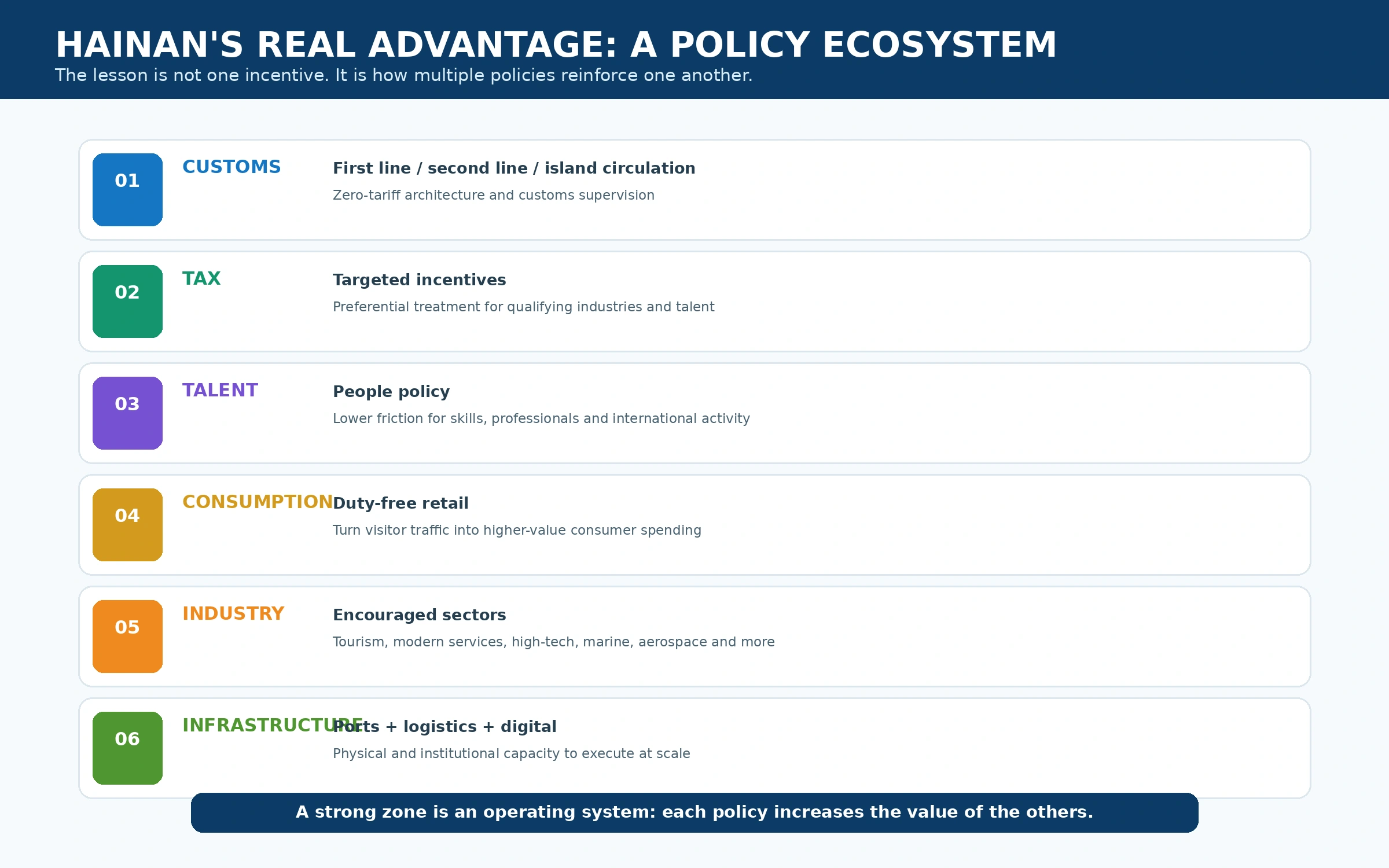
A customs policy changes the economics of imported inputs.
An industry catalogue directs those advantages toward selected sectors.
Talent policy makes it easier to staff those sectors.
Duty-free policy turns visitor traffic into consumer demand.
Ports, airports and logistics allow goods and people to move.
One-stop investment services reduce the friction between investor interest and execution.
The result is not one incentive.
It is an operating system.
Hainan crossed an important institutional threshold in December 2025
On 18 December 2025, the Hainan Free Trade Port formally launched island-wide special customs operations.
The official structure is often described through three concepts:
“First line” — between Hainan and countries or regions outside mainland China's customs territory;
the island — where special circulation and tax rules operate;
“second line” — between Hainan and the Chinese mainland.
This is not simply a border-control story.
It changes how goods are taxed and supervised as they enter Hainan, circulate inside the island and move onward to the mainland.
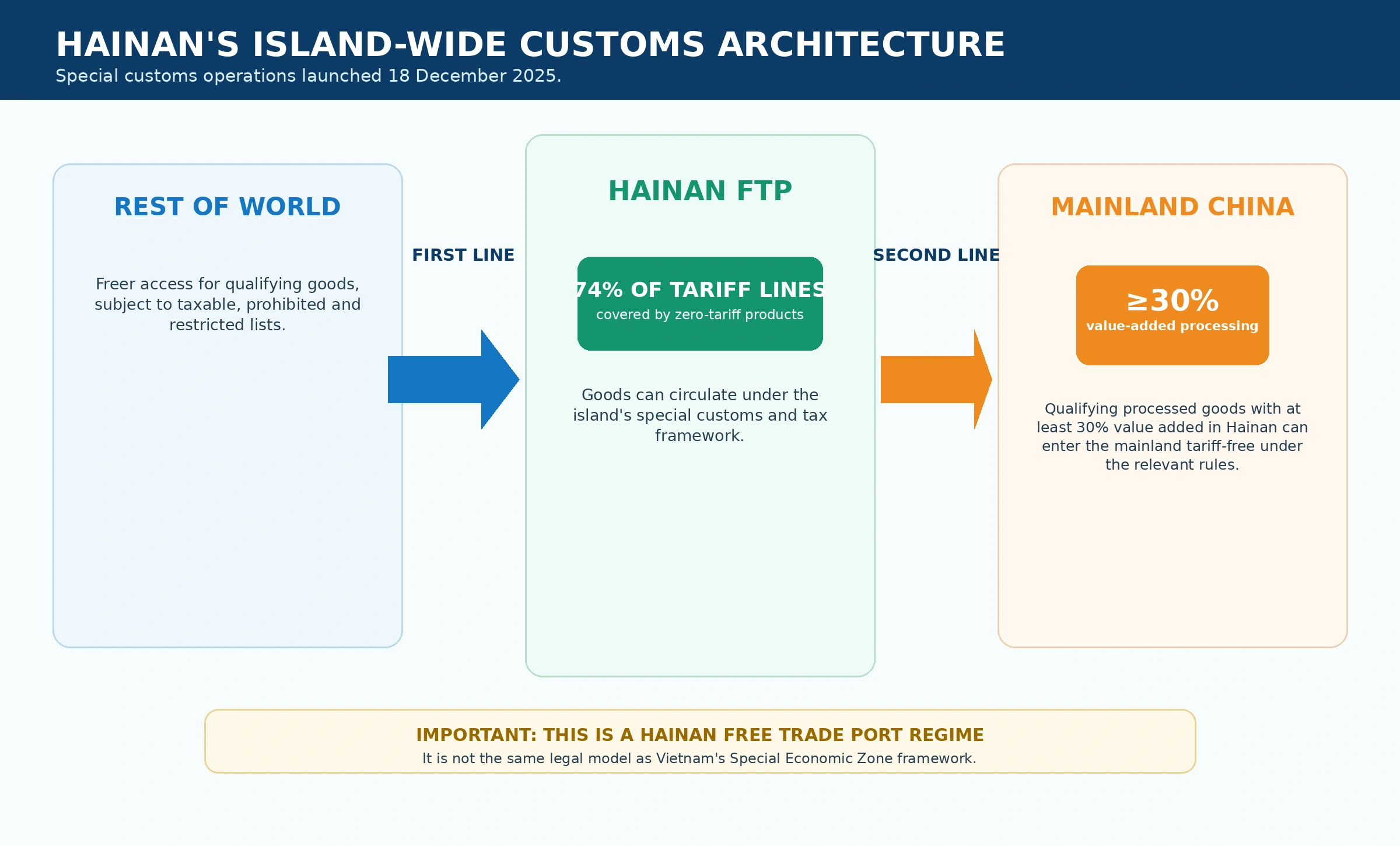
When the new customs-operation framework was announced, Chinese authorities stated that the proportion of tariff lines covered by zero-tariff products would increase from approximately 21% to 74%.
They also stated that qualifying imported goods processed in Hainan with at least 30% value added could enter the mainland tariff-free under the relevant rules.
For manufacturers, logistics operators and traders, these are not cosmetic benefits.
They can change:
input cost;
inventory location;
processing economics;
distribution strategy;
and the role of Hainan inside a wider supply chain.
This is where Hainan becomes more useful than a simple “duty-free island” comparison
Many people know Hainan because of offshore duty-free shopping.
That is understandable.
In the first seven months of 2026, offshore duty-free sales reached approximately RMB 21.6 billion, with around 3.11 million shoppers.
But duty-free is only one visible consumer-facing layer.
Behind it sits:
customs policy;
inventory management;
brands;
retail infrastructure;
air connectivity;
hotel and tourism demand;
digital payments;
and a massive domestic consumer market.
That last point is critical.
Hainan's duty-free performance cannot be transferred directly to Phu Quoc because the underlying consumer pool is fundamentally different.
Hainan has also moved beyond a tourism-only thesis
Hainan's official investment framework identifies tourism as only one part of the economy.
Other major areas include:
modern services;
high-tech industries;
high-efficiency tropical agriculture;
deep-sea economy;
aerospace;
medical and healthcare services;
high-end shopping;
digital economy;
and selected advanced manufacturing activities.
Official Hainan investment information reports that the value added of modern services increased from approximately RMB 151.2 billion in 2021 to RMB 214.8 billion in 2024, an average annual growth rate of about 9.2%.
This is important because a resilient island economy cannot rely on one demand source forever.
Tourism can remain a core engine.
But it should pull other sectors behind it.
Measured activity matters more than policy announcements
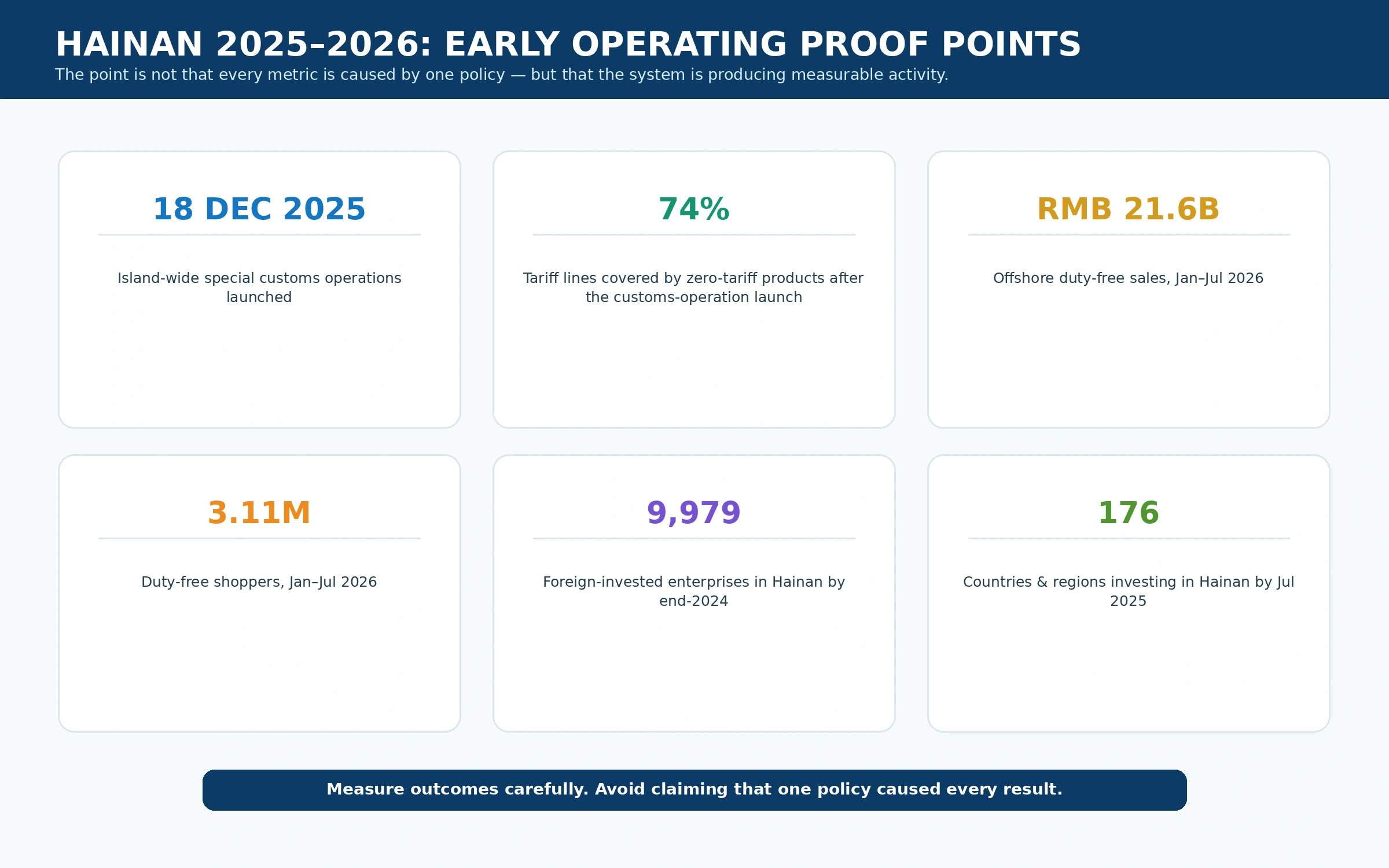
Hainan's official investment portal reported 9,979 foreign-invested enterprises by the end of 2024 and investors from 176 countries and regions by July 2025.
Following the launch of island-wide special customs operations, official local reporting stated that 1,016 new foreign-invested enterprises were registered between 18 December 2025 and the end of April 2026, 35.5% more than in the comparable period a year earlier.
These figures are interesting.
But a serious analysis should be careful with causality.
It would be too simplistic to say:
“The customs regime caused all of the investment growth.”
Hainan has spent years building infrastructure, industrial parks, tourism demand, business services and a regulatory framework.
The better interpretation is:
when a policy ecosystem reaches sufficient maturity, new policy layers can have a larger commercial effect because the rest of the system already exists.
This is the first major lesson for Phu Quoc: policies should be interoperable
Vietnam's new Special Economic Zone framework contains several potentially important mechanisms.
Planning.
Strategic investors.
Human resources.
Marine economy.
Non-tariff zones.
Duty-free retail.
The risk is to treat each one as a separate policy announcement.
That would waste much of their potential.
The larger opportunity is to ask how one mechanism increases the value of another.
For example:
faster planning + strategic investor → shorter time from commitment to construction;
non-tariff zone + duty-free + airport → stronger travel-retail economics;
talent policy + healthcare + education → more viable long-stay professional population;
marine policy + marina + yacht services → a real marine-services economy rather than isolated waterfront projects.
This is exactly where the Hainan comparison becomes useful.
The second lesson: know which sectors the island is actually designed to win
Hainan does not treat every industry equally.
Its encouraged-industry catalogue and investment strategy identify sectors that fit its resources, policy goals and infrastructure.
Phu Quoc will need the same discipline.
Not necessarily the same sectors.
For Phu Quoc, the stronger strategic candidates may include:
international tourism and hospitality;
MICE and events;
travel retail;
marina and yacht services;
aviation services;
international healthcare and education;
long-stay residence;
marine services;
tourism technology;
and selected high-value business services.
Trying to reproduce the entire Hainan industry map would be a mistake.
The third lesson: consumption policy must be connected to supply
Duty-free policy attracts attention because consumers can see it.
But a retail ecosystem also requires what consumers do not see:
warehousing;
customs supervision;
brand distribution;
inventory;
payment systems;
transport;
and airport or port collection systems.
This is why the most important real-estate opportunities around a consumption economy may not all be shopping malls.
Some may be:
logistics;
fulfilment;
commercial support;
staff housing;
or transport-linked assets.
Hainan reminds investors to look behind the storefront.
The fourth lesson: infrastructure has to serve a policy strategy
A port is not a strategy.
An airport is not a strategy.
A convention centre is not a strategy.
They are capacity.
The economic question is:
what activity will use that capacity repeatedly?
Hainan's port, airport, trade and industry policies are designed to interact.
Phu Quoc faces the same challenge after APEC 2027.
The island is building substantial new hardware.
Its investment value will depend on whether that hardware becomes:
routes;
events;
trade;
businesses;
residents;
and recurring cash flow.
What Phu Quoc should not copy
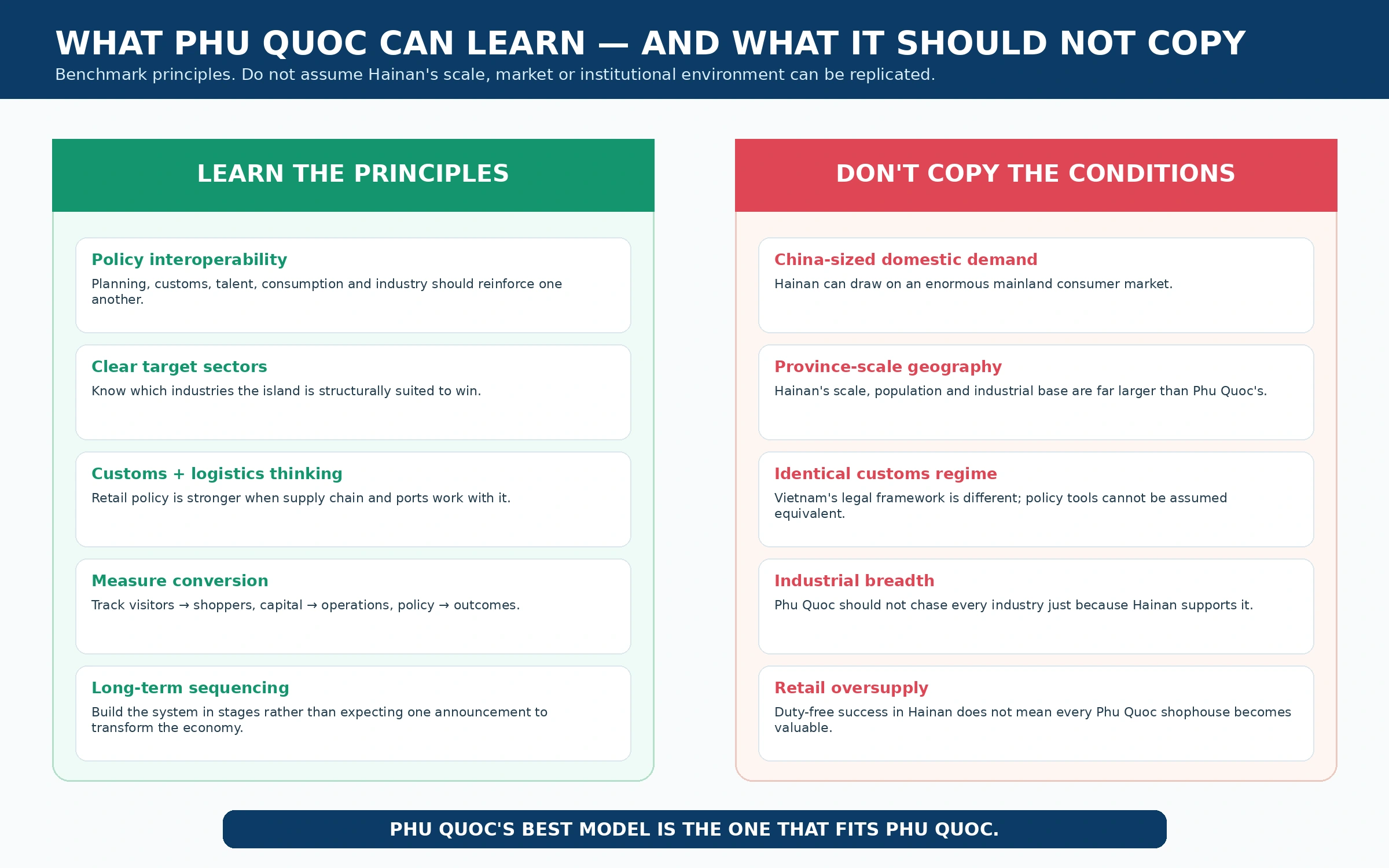
1. Do not copy Hainan's scale assumptions
Hainan can draw on China's enormous domestic market.
Phu Quoc cannot.
A Phu Quoc retail strategy therefore has to work with a smaller population and a much more international visitor mix.
2. Do not copy every industry
Hainan supports a wide industrial portfolio, including sectors linked to aerospace, seed technology, deep-sea industries and manufacturing.
Phu Quoc should be more selective.
Its land, environment and infrastructure are more constrained.
3. Do not assume the customs systems are equivalent
The Hainan Free Trade Port's “first line / second line” architecture is specific to China's legal and customs system.
Vietnam's Special Economic Zone framework is different.
4. Do not translate duty-free success into a blanket real-estate thesis
Hainan's duty-free sales do not prove that every retail property in Phu Quoc would become valuable.
Retail economics still require traffic, spending power, tenant quality, inventory and operating capability.
5. Do not mistake policy for execution
The existence of a mechanism is only the first step.
Investors should measure actual processing time, capital deployment, operating projects and customer behaviour.
What a “Phu Quoc model” could look like
If Hainan is a large Free Trade Port with a very broad economic mandate, Phu Quoc may be better suited to a more focused model.
One possible thesis is:
INTERNATIONAL RESORT + SERVICES ISLAND
with tourism as the demand engine and additional layers built around:
high-value consumption;
MICE;
marine economy;
healthcare;
education;
long-stay professionals;
aviation;
and selected international services.
This model does not require Phu Quoc to become an industrial island.
It requires the island to become more economically dense.
The investor metric I would borrow from Hainan is not GDP
I would borrow a more practical idea:
POLICY CONVERSION
For each major policy, ask:
Did it reduce a measurable cost?
Did it shorten a measurable time?
Did it increase a measurable transaction?
Did it attract a measurable operator?
Did it create a measurable new source of revenue?
If the answer remains unclear after several years, the policy may have narrative value but limited operating value.
Five indicators we would watch in a Phu Quoc version of this thesis
| Indicator | Why it matters |
|---|---|
| Time to Revenue | Does the policy system actually shorten the investor journey? |
| Spend per Visitor | Is tourism traffic converting into a higher-value consumption economy? |
| Capital Conversion | Does registered investment become operating assets? |
| Non-tourism Revenue Share | Is the island becoming more diversified? |
| International Business Base | Are companies beginning to use Phu Quoc as more than a leisure destination? |
Conclusion: Hainan's strongest lesson is systems thinking
The wrong conclusion from Hainan would be:
“Phu Quoc should copy Hainan.”
The better conclusion is:
A special economic framework becomes powerful when planning, customs, tax, talent, consumption, infrastructure and industry policy reinforce one another.
That is a lesson Phu Quoc can use.
But the final model has to fit Phu Quoc's own:
scale;
visitor mix;
environment;
infrastructure;
legal framework;
and competitive advantages.
Hainan is therefore best understood as a benchmark.
Not a blueprint.
If Phu Quoc eventually develops a successful Special Economic Zone model, its greatest achievement will not be looking like Hainan.
It will be building an operating system that makes sense for Phu Quoc.
Hainan customs framework: Hainan Provincial Government notice on island-wide special customs operations, effective 18 December 2025: official notice.
Zero-tariff scope: Chinese central-government reporting stated that zero-tariff coverage would rise from 21% to 74% of tariff lines and described the 30% value-added processing mechanism: State Council / Xinhua.
Duty-free: Hainan Provincial Government reported RMB 21.6 billion of offshore duty-free sales and 3.11 million shoppers in Jan–Jul 2026: Hainan official portal.
Investment environment: Hainan's official international investment portal reports 9,979 foreign-invested enterprises by end-2024 and investment from 176 countries and regions by July 2025: Invest in Hainan.
Industry diversification: official Hainan materials identify tourism, modern services, high-tech and tropical agriculture as pillar industries, alongside future-oriented areas such as deep sea and aerospace. Modern-services statistics are published by the provincial government: Modern Services.
Hainan and Phu Quoc operate under different legal systems. “Policy ecosystem”, “Policy Conversion” and the proposed Phu Quoc sector model are PhuQuocHome analytical frameworks, not official policy descriptions.