
Capital Hates Waiting: What Batam Can Teach Phu Quoc About Execution
Batam’s most useful lesson is not a promise of faster approvals. It is the importance of integrated investor services, regulatory certainty and measurable time from capital commitment to operating revenue.
Investors can model a high tax rate.
They can model expensive land.
They can model construction inflation.
What is much harder to model is:
“Maybe the decision takes three months. Maybe it takes three years.”
This is why one of the most important competitive advantages for an investment zone is not simply an incentive.
It is predictability.
Batam is useful to Phu Quoc because it is a real, operating island economy where industrial, logistics, port and investment-service systems have been built over decades.
But Batam should not be copied literally.
Its economic structure is different.
Its proximity to Singapore is unique.
Its manufacturing and logistics base is far deeper than Phu Quoc’s.
The transferable lesson is narrower and more powerful:
If a special economic framework is supposed to make investment easier, the investor must be able to feel the difference in time, clarity and execution.
Batam is not proof that “FTZ status causes growth”
Batam’s economy grew approximately 6.76% in 2025, according to official reporting based on Statistics Indonesia data. Its regional GDP reached approximately Rp 253.64 trillion.
Investment also accelerated strongly.
Under Indonesia’s LKPM investment-reporting series, realised investment in Batam reached approximately Rp 44.01 trillion in 2025, up 72.83% year on year from Rp 25.46 trillion.
BP Batam also publishes a separate bottom-up calculation, which measured 2025 investment at approximately Rp 69.30 trillion.
These are different methodologies.
They should not be added together or treated as interchangeable.
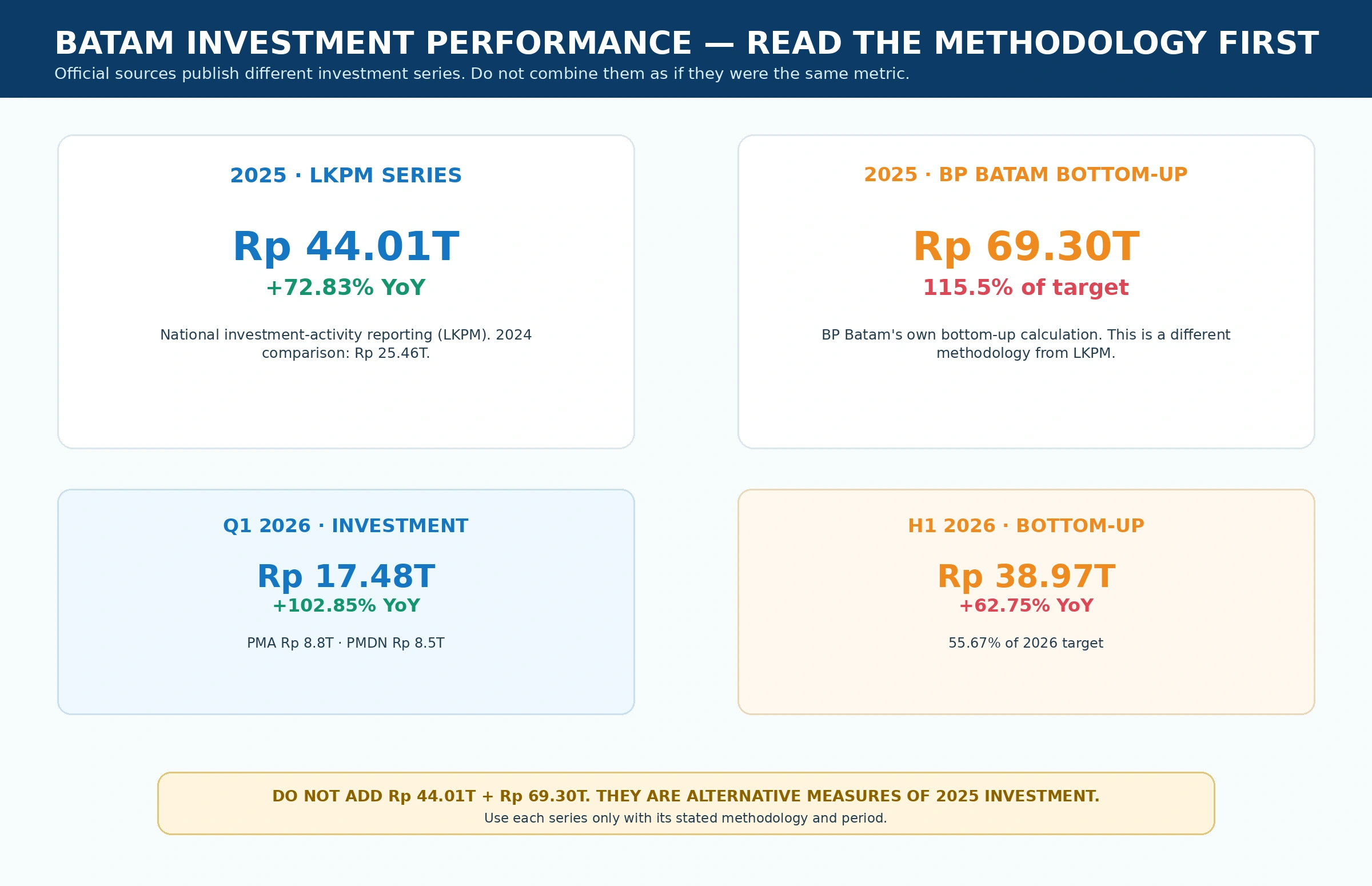
In Q1 2026, Batam recorded approximately Rp 17.48 trillion of investment, up 102.85% year on year.
Foreign investment (PMA) was approximately Rp 8.8 trillion and domestic investment (PMDN) approximately Rp 8.5 trillion.
BP Batam’s bottom-up series later reported approximately Rp 38.97 trillion for the first half of 2026, up 62.75% year on year.
These numbers show momentum.
But they do not prove that one policy — one-stop service, tax incentives or FTZ status — caused the growth.
Batam benefits from:
proximity to Singapore;
established industrial estates;
port infrastructure;
manufacturing supply chains;
shipyards;
electronics;
logistics;
and decades of accumulated investment.
The better investor question is therefore:
What part of Batam’s execution system is transferable?
One-stop service is not one counter
BP Batam’s One-Stop Integrated Service Centre (PTSP) manages multiple categories of permits, including land permits, business permits, goods-traffic permits and other administrative services.
Its electronic licensing environment is integrated with Indonesia’s national Online Single Submission (OSS) system and Batam’s I-BOSS platform for specific Batam Free Trade Zone / Free Port licensing processes.
This distinction matters.
A one-stop investment service is not valuable simply because an investor submits a form at one location.
The value appears when the process behind the front door becomes more integrated.
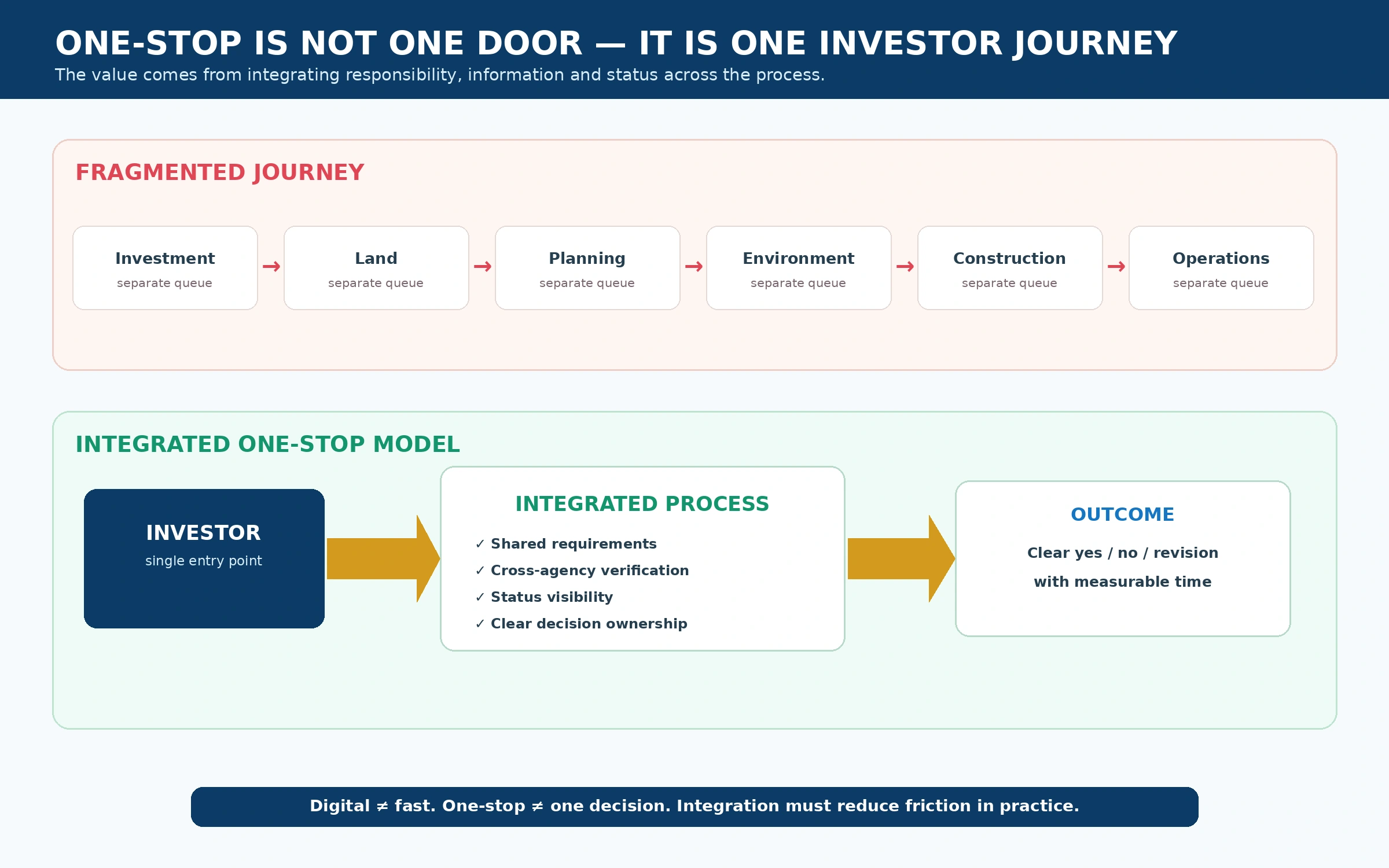
A project rarely needs only an “investment permit”.
It may require:
investment decisions;
land;
planning;
environmental approvals;
construction approvals;
goods and logistics procedures;
and operating licences.
If each stage remains a disconnected queue, the investor still has to integrate the government process personally.
That is not true one-stop service.
Digital is not the same as fast
An online application is useful.
But digitising a slow process can simply create a:
digital slow process.
Uploading documents online does not automatically reduce decision time.
Nor does a one-stop portal eliminate the need for verification, technical review or legal compliance.
The correct measure is not:
“Is there an online portal?”
The correct measures are:
How many times does the investor have to resubmit information?
How many agencies request the same document?
Who owns the final decision?
How long does each stage take?
Can the investor see the current status?
Technology is valuable when it reduces friction.
What Batam tells us about investor psychology
An investor can often accept a process that takes 180 days.
Why?
Because 180 days can be placed in a financial model.
The investor can plan:
equity drawdown;
debt financing;
contractor mobilisation;
staff recruitment;
opening date;
and expected revenue.
What is more difficult is a process where the investor cannot estimate whether the answer will arrive in six months or two years.
This creates regulatory uncertainty.
And uncertainty eventually enters valuation.
The right KPI is not “approval time” alone
Suppose an investment certificate is issued quickly.
But the land process then takes a year.
Environmental approvals take another year.
Construction cannot start.
The project is not actually faster.
This is why we prefer to measure the whole investor clock.
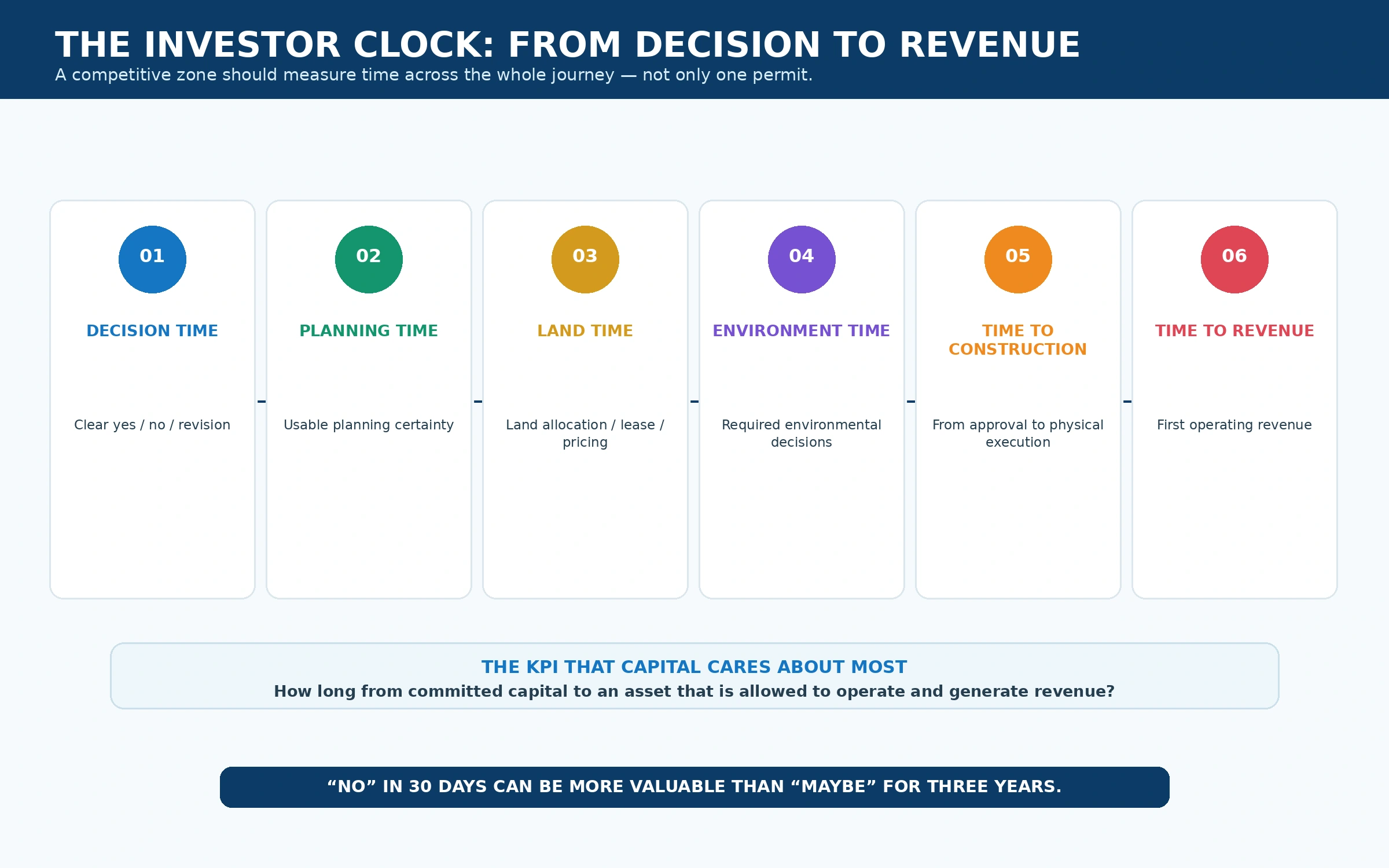
Six useful measures are:
Decision Time — time to a clear yes, no or revision request.
Planning Time — time to usable planning certainty.
Land Time — time to complete relevant allocation, leasing or pricing processes.
Environmental Time — time to complete required environmental decisions.
Time to Construction — time from investment decision to physical execution.
Time to Revenue — time until the project is operating and generating revenue.
The last measure is the one capital ultimately experiences.
Why “no” can sometimes be economically valuable
This sounds counterintuitive.
But an investor may prefer:
NO in 30 days
to:
MAYBE for three years.
If a project is incompatible with planning, environmental limits or sector strategy, an early rejection allows capital to move elsewhere.
A three-year uncertainty period can destroy opportunity without ever producing an approval.
This is why a professional investment system should optimise for:
clear decisions,
not simply:
more approvals.
Batam’s most important institutional lesson for Phu Quoc
Batam has an unusual institutional structure in which BP Batam plays a major role in investment, licensing, infrastructure and zone management.
Vietnam’s legal model is different.
But Vietnam’s 2026 Urban Development Law also creates mechanisms that could bring selected decisions closer to a Special Economic Zone.
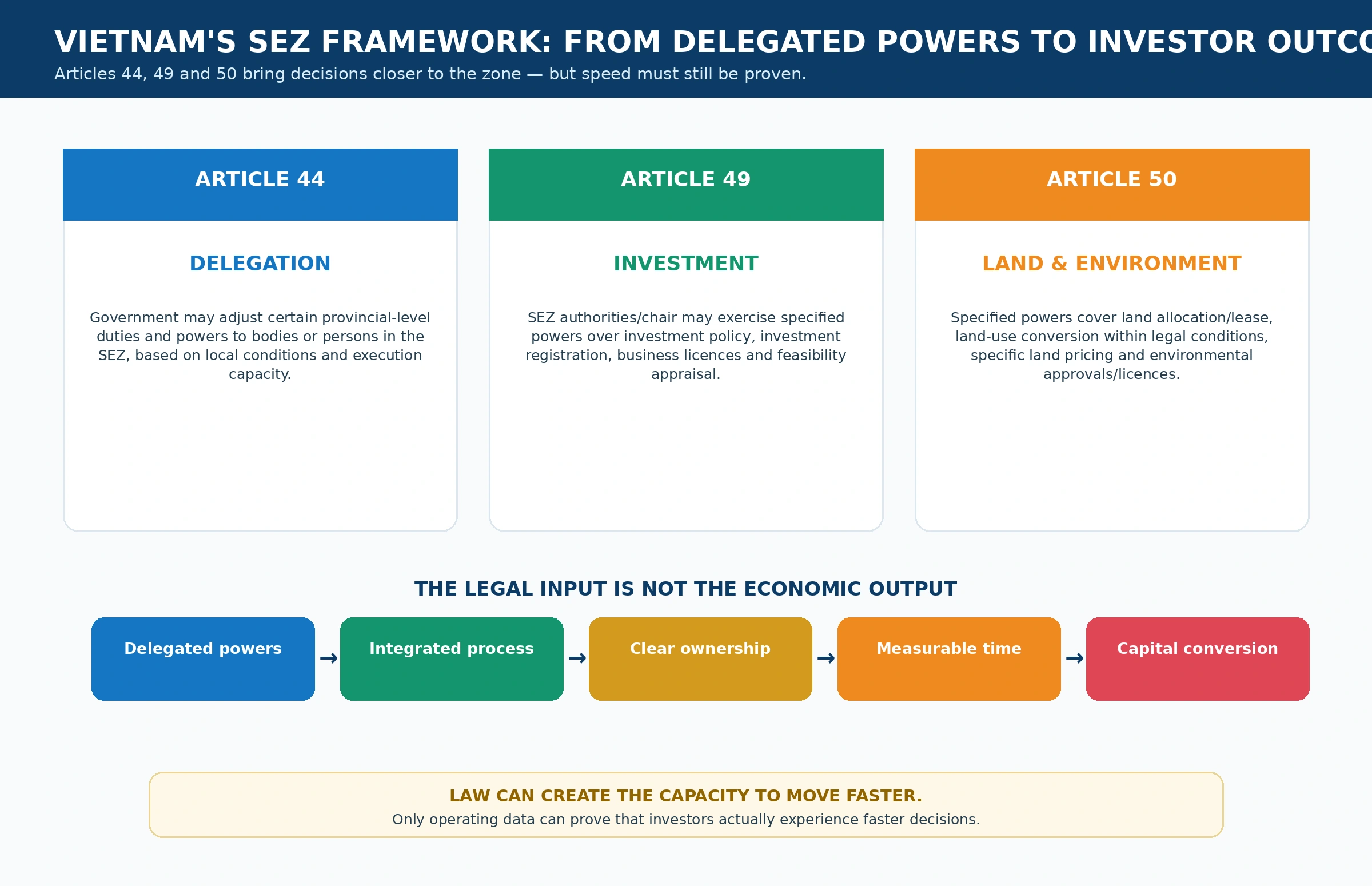
Article 44 allows the Government, based on local conditions, development direction and execution capacity, to adjust certain provincial-level duties and powers to authorities, organisations or persons in the SEZ.
Article 49 gives SEZ authorities and the SEZ chair specified powers concerning investment policy, investment registration, business licences, retail-establishment licences and feasibility-study appraisal.
Article 50 provides specified powers relating to land allocation and lease, land-use conversion within legal conditions, specific land pricing and environmental approvals and licences.
This creates an important possibility.
More decisions may be made closer to the economic zone itself.
But delegated authority is only an input.
Investors care about the output.
Does the process become faster?
Does it become more predictable?
Does the number of handoffs decrease?
Does capital reach construction faster?
That is the Batam lesson.
Delegation is not the same as certainty
A local authority can receive more powers and still operate slowly.
A one-stop service can exist while internal coordination remains fragmented.
An online portal can exist while processing times remain uncertain.
So the chain investors should watch is:
delegated powers
→ integrated process
→ clear ownership
→ measurable time
→ capital conversion.
If the chain breaks at any point, the economic benefit is weaker.
Batam also shows why an island needs an economic identity
Batam’s comparative advantage is not simply “special regulation”.
Its location near Singapore, manufacturing base, ports, shipyards, electronics and logistics ecosystem give investors a clear reason to operate there.
In Q1 2026, official Batam data showed major investment shares in machinery and electronics, chemicals and pharmaceuticals, other services, and housing/industrial-estate/office activity.
Batam is therefore not selling one generic message:
“Come because we are special.”
It has sectors that already fit its economic geography.
Phu Quoc must do the same.
Phu Quoc should not copy Batam’s industrial model
Phu Quoc’s strongest structural advantages are different.
It is a global tourism destination.
It has limited land and environmental carrying capacity.
Its strongest opportunities may lie in:
international hospitality;
MICE;
travel retail;
marine and marina services;
aviation services;
healthcare;
education;
long-stay residence;
and selected international services.
Trying to become another manufacturing island would miss the point.
The relevant Batam lesson is execution discipline, not sector imitation.
What would prove that a Phu Quoc SEZ is genuinely faster?
| Indicator | Question investors should ask |
|---|---|
| Decision Time | How long until the investor receives a clear decision? |
| Planning Time | How long until planning is sufficiently clear to commit capital? |
| Land Time | How long do relevant land procedures take? |
| Environmental Time | How long until environmental requirements are resolved? |
| Time to Construction | How long from investment decision to physical start? |
| Time to Revenue | How long until the project begins operating? |
| Capital Conversion | How much registered capital becomes disbursed capital? |
| Project Operation Rate | How many approved projects actually enter operation? |
If these indicators improve, the SEZ framework is creating a measurable competitive advantage.
If they do not, the legal framework may be impressive while the investor experience remains ordinary.
Conclusion: Capital hates waiting — but it also hates uncertainty
Batam’s investment momentum is interesting.
Its one-stop institutional architecture is interesting.
Its digital licensing systems are interesting.
But none of these should be copied as slogans.
The deeper lesson is:
an investment zone becomes competitive when institutional powers are converted into a journey that businesses can understand, measure and trust.
For Phu Quoc, the opportunity is not to become another Batam.
It is to use the legal flexibility of a future Special Economic Zone framework to reduce the economic cost of waiting — while maintaining planning, environmental and legal discipline appropriate for an island.
If that happens, “special” will no longer be a policy label.
It will be something an investor can see on the clock.
Batam investment: BP Batam reported 2025 LKPM realised investment of Rp 44.01 trillion, up 72.83% year on year, while its separate bottom-up methodology produced Rp 69.30 trillion. The two series are kept separate in this article: BP Batam, 23 Jun 2026.
Q1 2026: BP Batam reported approximately Rp 17.48 trillion of investment, up 102.85% year on year: BP Batam.
H1 2026: BP Batam’s bottom-up series reported Rp 38.97 trillion, up 62.75% year on year: BP Batam, 20 Aug 2026.
Economic growth: official BP Batam reporting based on Statistics Indonesia data recorded 6.76% economic growth in 2025 and regional GDP of approximately Rp 253.64 trillion: BP Batam.
One-stop services: PTSP BP Batam describes integrated permit services covering land, business, goods traffic and other permissions, linked electronically to OSS and I-BOSS: PTSP BP Batam.
Vietnam legal framework: Articles 44, 49 and 50 of Urban Development Law No. 18/2026/QH16. English explanations here are analytical summaries, not official legal translations.
Concepts such as the Investor Clock, Time to Revenue and Capital Conversion are PhuQuocHome investment-research frameworks.