
Phu Quoc 2030: Three Scenarios and One Investment Thesis After APEC 2027
A scenario-based investment outlook for Phu Quoc: infrastructure, international demand, capital conversion, capacity constraints and the possible Special Economic Zone framework.
If someone asks for one number that describes Phu Quoc in 2030, our answer is simple:
one number would create false precision.
Between 2026 and 2030, several forces will interact at the same time:
APEC 2027;
airport and transport capacity;
water and environmental infrastructure;
international visitor demand;
registered and disbursed investment;
strategic investors;
new sectors such as MICE, retail, marine services, healthcare and education;
and the possible future application of Vietnam's Special Economic Zone framework to Phu Quoc.
The correct investor approach is therefore not to forecast one future.
Build several plausible futures, define what must be true for each one, and update conviction as operating data arrives.
The starting position is already substantial
Phu Quoc is not a greenfield island economy.
Official local reporting recorded approximately 8.3 million visitors in 2025, up 38.51% year on year, including approximately 1.86 million international visitors, up 93.62%.
Tourism and services account for roughly 70% of Phu Quoc's production-value structure and around 70% of employment.
The investment base is also large.
As of June 2026, the Phu Quoc Economic Zone had 326 projects in force, covering more than 10,549 hectares, with approximately VND 508.660 trillion of registered capital.
Approximately VND 31.603 trillion was disbursed in the first half of 2026, and official Q2 reporting stated that 58 projects were already operating.
This leads to a central conclusion:
Phu Quoc does not lack investment narratives. The 2026–2030 challenge is converting existing narratives, infrastructure and capital into operating economic capacity.
APEC 2027 is building the hardware
Official reporting states that Phu Quoc is implementing 21 projects for APEC 2027 with total investment exceeding VND 137.138 trillion.
That programme includes major airport, transport, conference, water, environmental and urban infrastructure.
The multi-functional APEC complex alone carries approximately VND 21.860 trillion of investment, while the airport expansion programme is approximately VND 22 trillion.
Recent official reporting also indicates that a number of key projects are meeting or exceeding planned progress.
This is a major build-out.
But hardware does not automatically become an economy.
An airport is capacity.
A convention centre is capacity.
A new road is capacity.
Economic value appears only when those assets are repeatedly used by:
visitors;
businesses;
operators;
residents;
and capital.
The legal framework is relevant — but recognition and implementation are separate stages
Vietnam's Urban Development Law No. 18/2026/QH16 creates a national legal framework for Special Economic Zones.
Article 43 requires a separate Government recognition process after approval in principle by the competent authority.
This research therefore does not assume that Phu Quoc has already been formally recognised as a Special Economic Zone under that law.
The law creates optionality.
Implementation determines value.
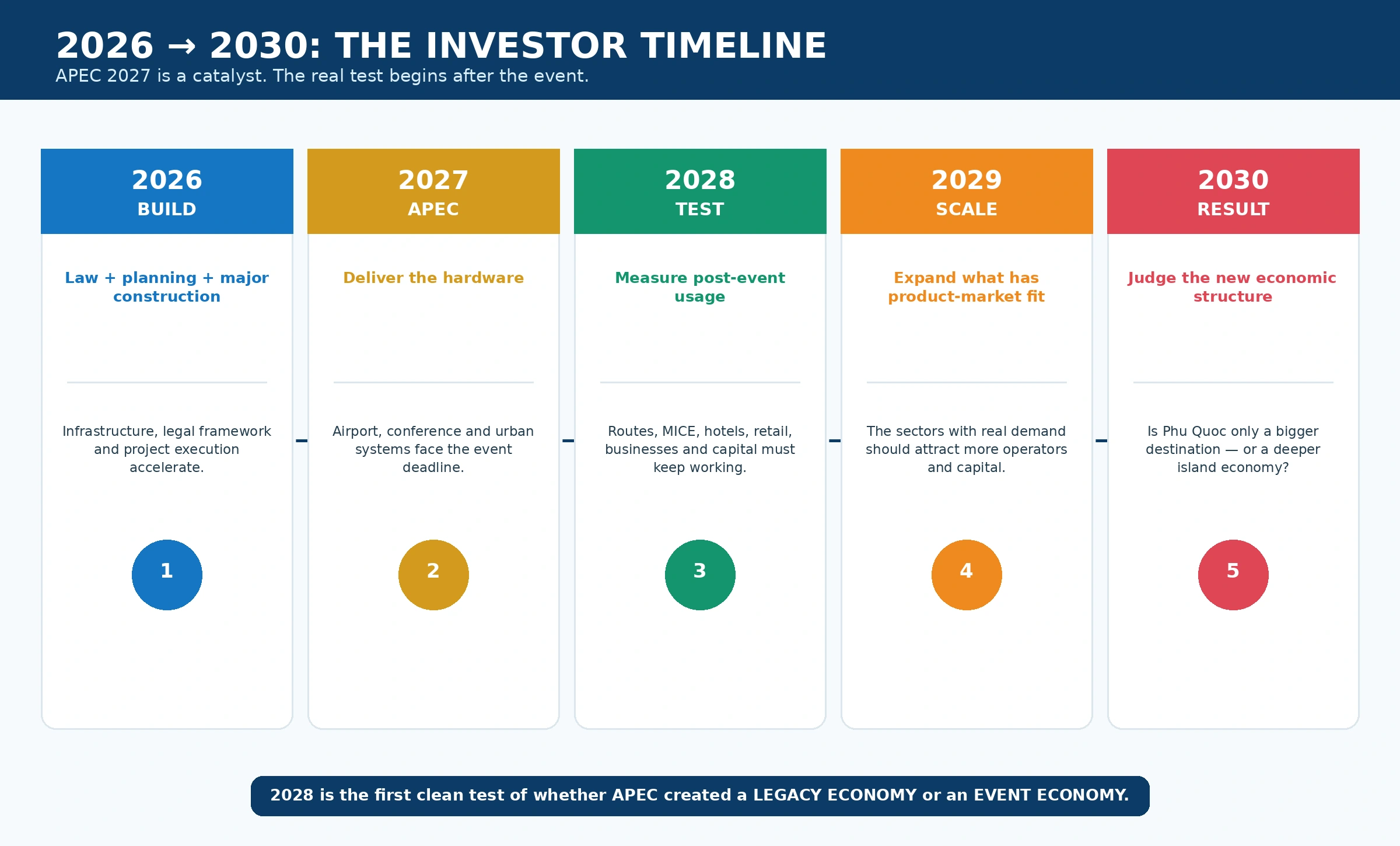
Why 2028 may matter more to investors than 2027
APEC 2027 will naturally create a period of exceptional activity.
Construction is accelerated.
International attention rises.
Hotel and event demand may be unusually strong.
But for long-term capital, the more important year may be:
2028.
That is the first clean test after the event.
Do new international routes remain?
Does MICE activity continue?
Do hotels maintain healthy occupancy?
Does retail spending remain strong?
Do new businesses continue entering?
Do completed projects operate?
If the answer is broadly yes, APEC may have created a legacy economy.
If activity falls sharply once the event is over, much of the impact may have been an event economy.
Three scenarios for Phu Quoc in 2030
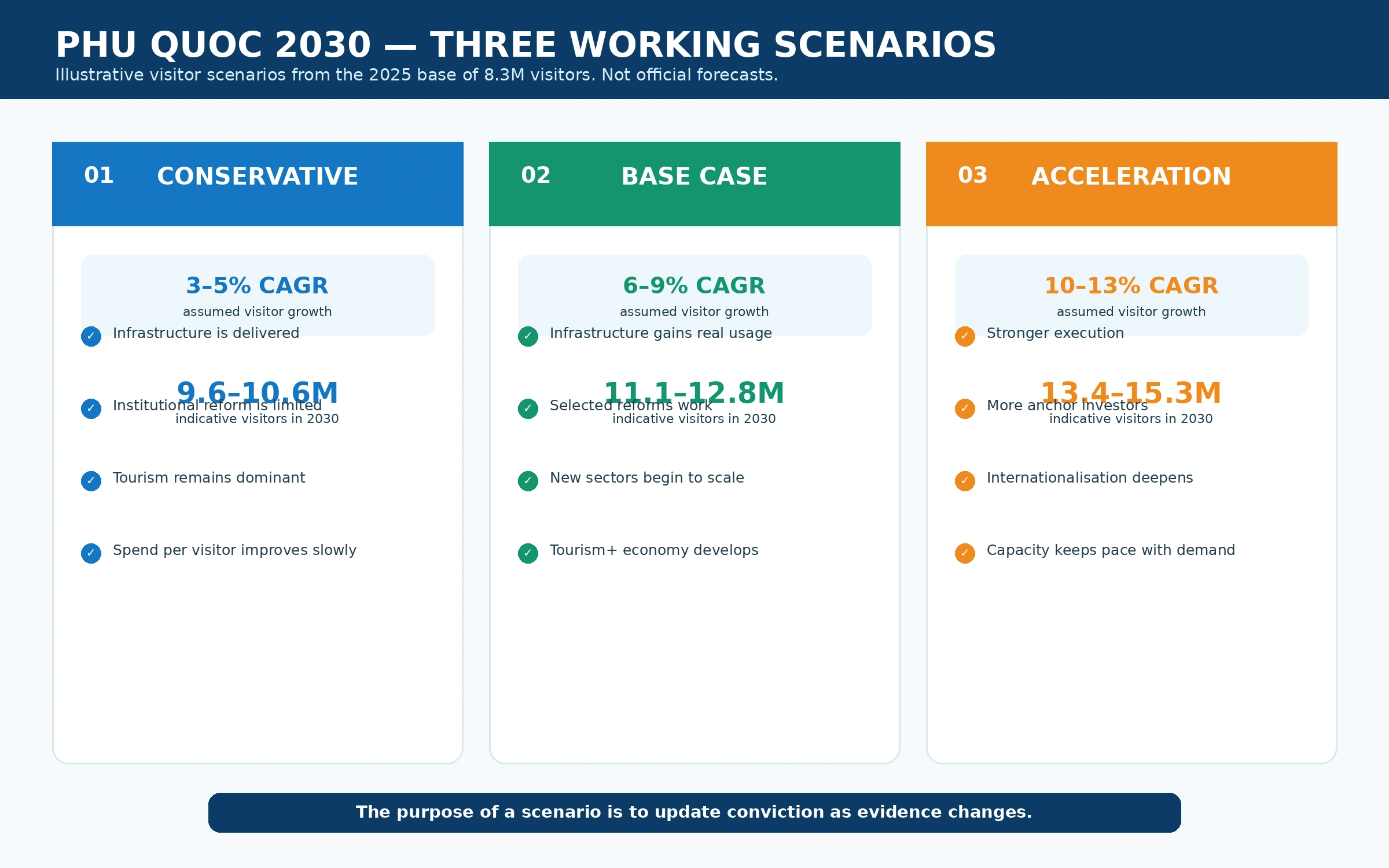
We use the 2025 visitor base of 8.3 million only as a simple demand proxy.
The scenarios below are not official forecasts.
They are analytical ranges calculated using assumed compound annual visitor growth between 2025 and 2030.
| Scenario | Assumed visitor CAGR 2025–2030 | Indicative 2030 visitors |
|---|---|---|
| Conservative | 3–5% | 9.6–10.6M |
| Base Case | 6–9% | 11.1–12.8M |
| Acceleration | 10–13% | 13.4–15.3M |
Scenario 1 — Conservative: a larger tourism economy, but not a fundamentally new one
In this scenario, the APEC infrastructure programme is largely delivered.
The airport is larger.
Roads improve.
Hospitality capacity expands.
Visitor numbers continue growing.
But the economic structure remains concentrated in tourism, hotels, F&B and entertainment.
Special Economic Zone mechanisms, if eventually applied, produce only moderate execution improvements.
Duty-free does not become a major consumption engine.
Marine services remain limited.
Healthcare and education do not yet create a substantial long-stay population.
Under an assumed 3–5% visitor CAGR, Phu Quoc reaches approximately 9.6–10.6 million visitors by 2030.
This is still a substantial destination.
But it is mainly a:
BIGGER TOURISM ECONOMY.
Scenario 2 — Base Case: Tourism+
This is our current working middle case.
Not because we claim to know the future.
But because it assumes partial execution rather than either failure or perfect execution.
In this scenario:
APEC infrastructure gains real post-event usage;
international connectivity continues expanding;
planning and investment procedures become clearer;
a number of strategic investors enter missing sectors;
MICE activity becomes more regular;
travel retail and higher-value consumption improve;
long-stay demand becomes measurable;
and selected marine, healthcare, education and international-service activities begin scaling.
Tourism remains the engine.
But it begins pulling a second layer of economic activity behind it.
We call this:
TOURISM+.
Under a 6–9% visitor CAGR assumption, the range is approximately 11.1–12.8 million visitors in 2030.
Scenario 3 — Acceleration: an international island economy
This is the most attractive scenario.
It is also the most demanding.
It requires multiple systems to work at the same time:
stronger planning certainty;
faster investor decisions;
high capital conversion;
credible anchor investors;
deeper international connectivity;
real travel-retail economics;
MICE;
marine and marina services;
international healthcare and education;
long-stay residents;
and sufficient water, energy, transport and environmental capacity.
If these systems work together, Phu Quoc begins moving beyond the economics of a destination.
It starts behaving more like an:
INTERNATIONAL ISLAND ECONOMY.
An assumed 10–13% visitor CAGR produces an indicative range of approximately 13.4–15.3 million visitors by 2030.
But this scenario immediately creates a second question:
Can the island carry that much economic activity?
Capacity is not a footnote — it is one of the main investment variables
Phu Quoc International Airport's approved planning framework targets approximately 10 million passengers per year by 2030 and approximately 18 million passengers per year by 2050.
A tourism visitor and an airport passenger movement are not the same metric, so the figures cannot be compared one-for-one.
But the airport plan illustrates a wider point.
High-demand scenarios eventually collide with capacity.
Not only airport capacity.
Also:
roads;
ports;
water;
electricity;
wastewater;
waste management;
housing;
healthcare;
and environmental carrying capacity.
A strong demand story can still become a weak investment story if the island cannot expand capacity fast enough.
The Phu Quoc 2030 equation
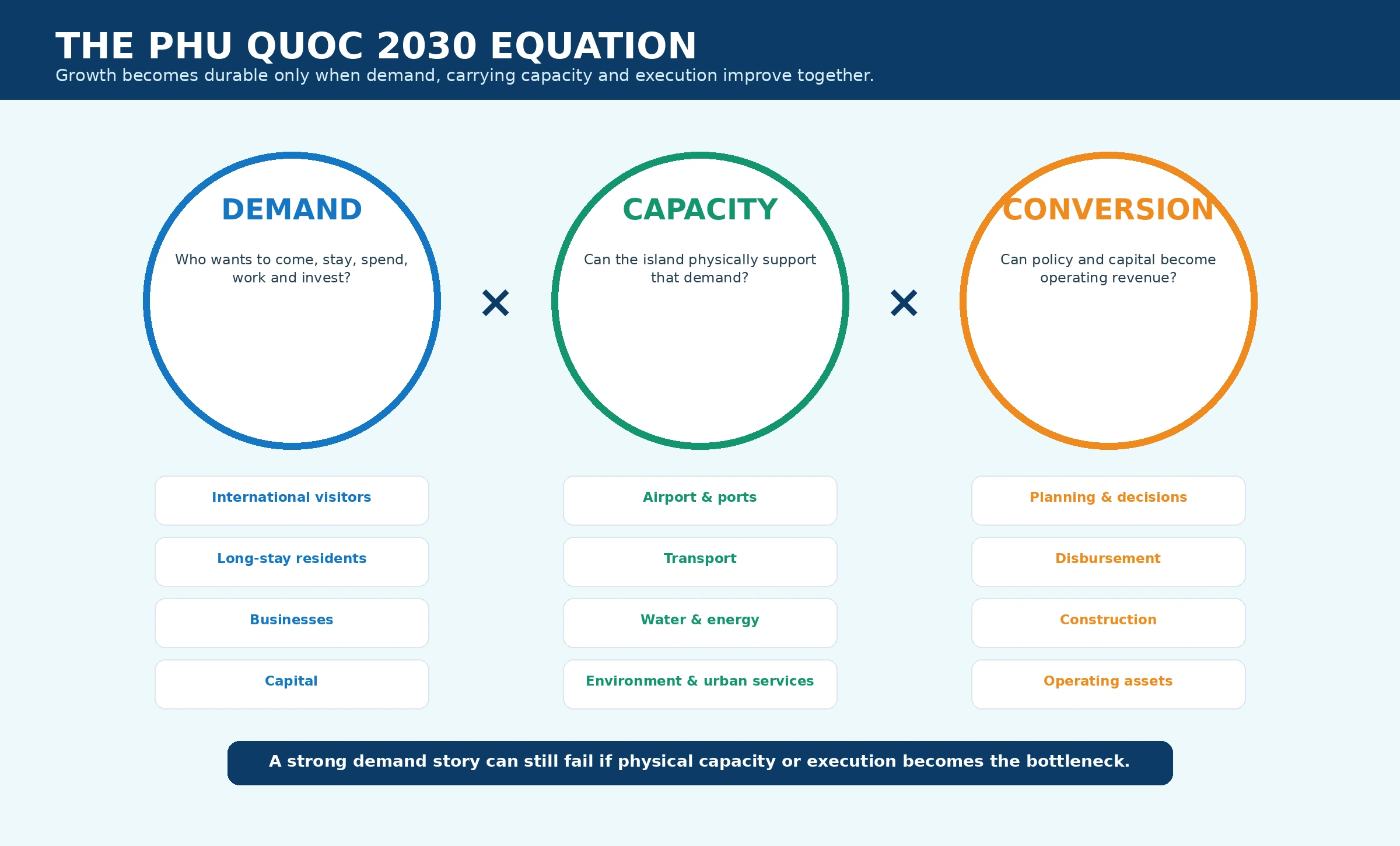
After this research series, we can reduce the entire 2030 thesis to three variables.
1. DEMAND
How many people want to:
visit;
stay;
work;
spend;
build businesses;
and allocate capital in Phu Quoc?
2. CAPACITY
Can the island support that demand through:
airport and port capacity;
transport;
water;
energy;
environmental systems;
housing;
healthcare;
education;
and urban services?
3. CONVERSION
How efficiently can Phu Quoc convert:
planning → approvals → land → capital → construction → operations → revenue?
Our thesis is therefore:
Demand × Capacity × Conversion = Phu Quoc's long-term trajectory.
If one variable is weak, growth becomes harder to sustain.
The most important investment number may not be visitor growth
Visitor volume is useful.
But it is not enough.
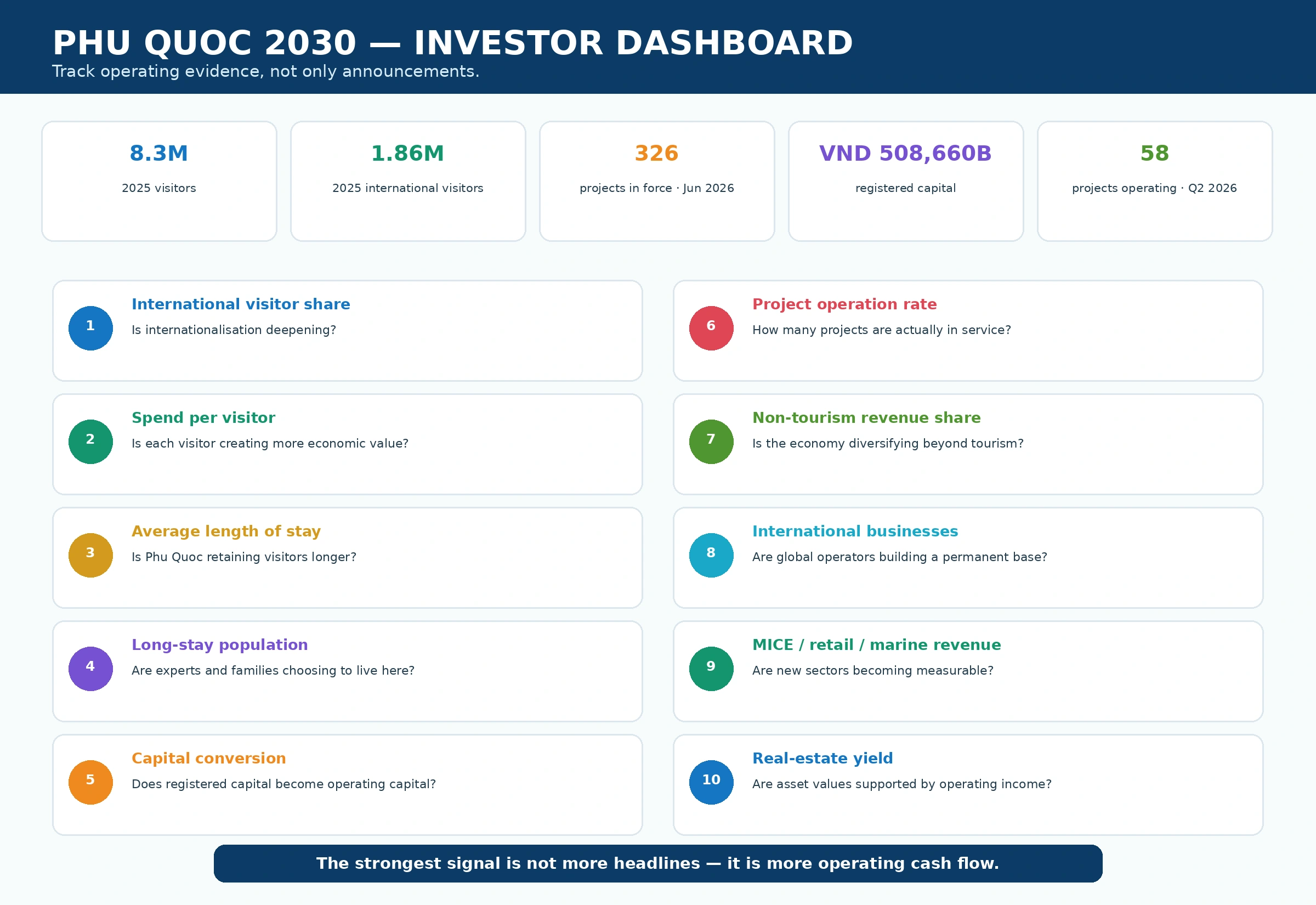
A more valuable dashboard asks:
What percentage of visitors are international?
How much does each visitor spend?
How long do they stay?
How many professionals and families live on the island for months or years?
How much registered capital becomes disbursed capital?
How many approved projects actually operate?
How much economic output comes from sectors outside conventional tourism?
Are operating real-estate yields improving?
Capital conversion will remain one of our highest-conviction indicators
Phu Quoc already has approximately VND 508.660 trillion of registered investment capital.
That number is impressive.
But by Q2 2026, official reporting identified 58 operating projects out of 326 projects in force.
The interpretation requires care.
Projects can be at different stages, scales and legal conditions, so 58 divided by 326 is not a simple measure of investment success.
But the data reinforces why we care about the conversion chain:
registered → disbursed → built → operating → revenue.
If that chain improves materially by 2030, our conviction increases.
If announcements grow faster than operating assets, conviction falls.
What would move us from the Base Case toward Acceleration?
We would want several signals to improve together.
Formal legal progress — clear recognition and implementing rules if the Special Economic Zone framework is eventually applied to Phu Quoc.
Planning execution — general and detailed planning becomes faster, clearer and less contradictory.
Anchor investors — credible operators commit and disburse capital in sectors Phu Quoc is currently missing.
International demand quality — international share, spend per visitor and average length of stay rise together.
Post-APEC usage — airport, convention, transport and urban assets remain actively used in 2028 and beyond.
Physical carrying capacity — water, environmental and transport systems keep pace.
One announcement would not be enough.
The upgrade requires a cluster of evidence.
What would move us toward the Conservative Case?
The opposite signals would matter just as much.
Infrastructure is completed but usage is weak.
Hotel and retail supply rises faster than demand.
Registered investment increases while disbursement remains slow.
Water, wastewater, waste or transport constraints remain persistent.
International traffic grows but spend and length of stay do not.
Property prices rise significantly faster than rents, occupancy and operating income.
The last signal is especially important.
If:
LAND PRICE ↑↑↑
while:
RENT → OCCUPANCY → REVENUE
remain broadly flat, the island may be experiencing:
asset inflation
rather than:
economic deepening.
Why the real-estate opportunity may change shape
In a tourism-led property market, the easiest thesis is often:
buy land;
wait for infrastructure;
wait for planning;
sell to the next buyer.
A deeper economy changes the questions.
Investors begin asking:
What is the NOI?
What is the occupancy?
Who is the tenant?
Who is the operator?
What is the lease term?
What is the yield?
What is the payback period?
That would represent a gradual movement from a:
LAND MARKET
toward an:
ASSET MARKET.
This is one of the most important long-term implications of a deeper island economy.
The opportunity map is therefore economic, not simply geographic
By 2030, we would analyse Phu Quoc through economic nodes rather than asking only which district or road is “hot”.
Airport / Dương Tơ / Đường Bào — connectivity, airport commercial, serviced residence, logistics and business services.
Dương Đông — real urban economy, recurring residential demand, retail, healthcare, education and operating hospitality.
South Island / An Thoi — international visitor economy, MICE, entertainment, destination retail, hospitality and potentially marina-linked services.
Vinh Dam / port-linked areas — logistics, marine services and commercial support.
Healthcare and education nodes — long-stay family demand and recurring local consumption.
Marine economy — marina, yacht services, marine tourism, selected aquaculture technology and logistics.
This is not a recommendation to buy land in any of these areas.
The correct investment question remains:
What economic activity will create repeat demand for this asset?
The biggest opportunity may eventually be operating assets rather than owning land
If the Base or Acceleration scenario develops, the opportunity set broadens beyond property ownership.
Examples include:
property management;
hotel operations;
facility management;
retail intelligence;
tourism data;
marine services;
healthcare operations;
education;
logistics;
and asset management.
In other words:
operating the economy may become as important as owning the real estate underneath it.
2030 should not be judged by whether Phu Quoc reaches 15 million visitors
For an island, maximising headcount is not necessarily the correct objective.
Land is finite.
Water is finite.
Environmental capacity is finite.
Transport capacity is finite.
A higher-quality development model should increasingly optimise:
value per visitor;
value per resident;
value per business;
value per hectare.
Eleven million visitors who stay longer, spend more and support year-round business activity may create a stronger economy than fifteen million lower-value visitors who create significantly greater physical pressure.
The six-part English research series leads to one conclusion
Research 01: Phu Quoc already has structural advantages.
Research 02: planning time is a capital issue.
Research 03: Hainan shows why policies need to operate as a system.
Research 04: Batam shows why capital hates waiting.
Research 05: strategic investors should be productive capital, not merely large capital.
And Research 06 concludes:
none of these advantages matter in isolation. The investment case depends on whether they reinforce one another.
Our Phu Quoc 2030 investment thesis
We are not investing intellectually in the thesis:
“Phu Quoc may become a Special Economic Zone, therefore land prices rise.”
That is too shallow.
Our thesis is:
Phu Quoc is simultaneously upgrading infrastructure, internationalising demand and opening the possibility of a new institutional framework. If these factors create more operating businesses, higher-value consumption, a long-stay population and productive capital throughout the year, the island can deepen economically far beyond another property cycle.
But this is a conditional thesis.
If institutions do not execute, infrastructure is underused or capital does not convert into operating assets, the thesis weakens.
Conclusion: the biggest opportunity is recognising a new economy before it becomes obvious
By 2030, the most important questions will not be:
What is Phu Quoc called?
How many projects were announced?
How much did land prices rise?
The important questions will be:
How many businesses operate?
How many international professionals live here?
How much does each visitor spend?
How many projects generate revenue?
How much registered capital becomes productive capital?
How much of the economy operates throughout the year?
If those answers improve substantially, Phu Quoc will not need to become “another Hainan”, “another Jeju” or “another Batam”.
It will have built a model of its own.
A tourism powerhouse.
An international service economy.
A marine economy.
A consumption economy.
A long-stay economy.
And a more mature operating-asset market.
The biggest Phu Quoc opportunity may no longer be buying a piece of land before everyone else. It may be recognising a new economic structure before everyone else.
Tourism: official Phu Quoc reporting recorded approximately 8.3 million visitors in 2025, including 1.86 million international visitors: Phu Quoc official portal.
Economic structure: official local reporting states that tourism and services account for approximately 70% of Phu Quoc's production-value structure and around 70% of employment: official source.
Investment: as of June 2026, the Phu Quoc Economic Zone had 326 projects in force, more than 10,549 ha, approximately VND 508.660 trillion of registered investment and VND 31.603 trillion disbursed in H1 2026: Phu Quoc Economic Zone Authority. Q2 reporting stated that 58 projects were operating: Q2 2026 report.
APEC 2027: official sources report 21 projects with total investment above VND 137.138 trillion: APEC infrastructure update.
Airport: the approved airport plan targets approximately 10 million passengers/year by 2030 and 18 million by 2050: airport planning announcement.
Legal framework: Urban Development Law No. 18/2026/QH16. Article 43 requires a separate Government recognition process for Special Economic Zone status. This article does not assert that Phu Quoc has already received that recognition.
Scenario methodology: 2030 visitor ranges are PhuQuocHome analytical scenarios calculated from the 2025 base of 8.3 million visitors using assumed CAGR ranges of 3–5%, 6–9% and 10–13%. Demand × Capacity × Conversion, Tourism+, Legacy Economy and the investor dashboard are PhuQuocHome research frameworks, not official forecasts.