
Strategic Investors: Why Phu Quoc Needs Productive Capital, Not Just Bigger Projects
Article 48 creates a legal framework for strategic investors in Special Economic Zones. The investment question is whether Phu Quoc can use that framework to attract anchor investors that create capabilities, networks, demand and long-term local value.
“Strategic investor” is one of the easiest labels to overuse.
A company announces a large project.
The project covers hundreds of hectares.
The investment figure reaches tens of trillions of Vietnamese dong.
The investor is immediately described as strategic.
That is not how long-term investors should think about the term.
A strategic investor should be judged not only by the amount of capital it brings into one project, but by the economic capability that appears around that project after the capital arrives.
A strong airport investor can improve connectivity.
A credible marina operator can create a marine-services network.
An international hospital or school can help the island retain professionals and families.
A sophisticated travel-retail operator can convert visitor traffic into higher-value consumption.
The important concept is not simply big capital.
It is productive capital.
Article 48 turns “strategic investor” into a defined legal category
Article 48 of Vietnam’s Urban Development Law No. 18/2026/QH16 establishes a specific framework for attracting strategic investors in a Special Economic Zone.
The law does not create one universal project-size threshold.
It defines different priority sectors and different minimum investment scales.
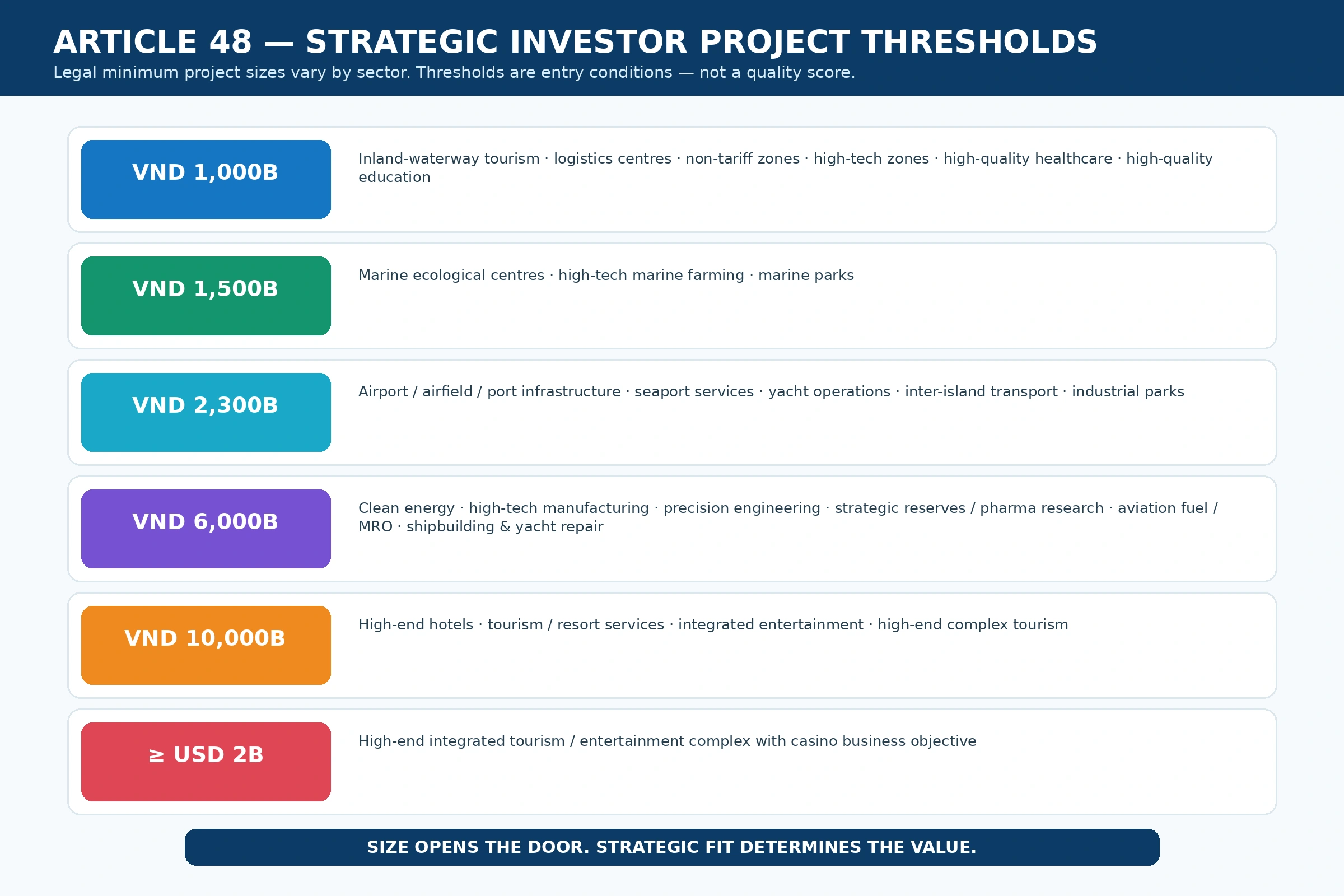
Selected examples include projects of at least VND 1,000 billion in areas such as logistics centres, non-tariff zones, high-tech zones, high-quality healthcare and high-quality education.
Marine ecological centres and high-tech marine farming begin at VND 1,500 billion.
Airport, port and selected transport infrastructure, seaport services and yacht operations begin at VND 2,300 billion.
Several clean-energy, high-tech manufacturing, aviation-services and shipbuilding / repair categories use a threshold of VND 6,000 billion.
High-end hotel, resort, integrated entertainment and complex tourism projects begin at VND 10,000 billion.
For a high-end integrated tourism and entertainment project with a casino business objective, the law states an investment scale equivalent to at least USD 2 billion.
These figures matter.
But they are only the entrance gate.
Size is a filter — not proof of strategic value
This distinction is important because global SEZ experience shows that large minimum-investment criteria can have unintended effects.
A World Bank review of Special Economic Zones noted that strict criteria on size, investment level or job creation can sometimes prevent too many firms from entering, rather than ensuring the right firms enter.
The same review argues that a more effective approach can be to target key anchor investors that match the desired sector profile.
Successful anchor investors can play a signalling role and often bring suppliers and partners with them.
That is exactly the lens I would apply to Phu Quoc.
Article 48 answers: “How large must the project be?” Phu Quoc still has to answer: “Why is this the right investor for this island?”
Article 48 also demands balance-sheet commitment
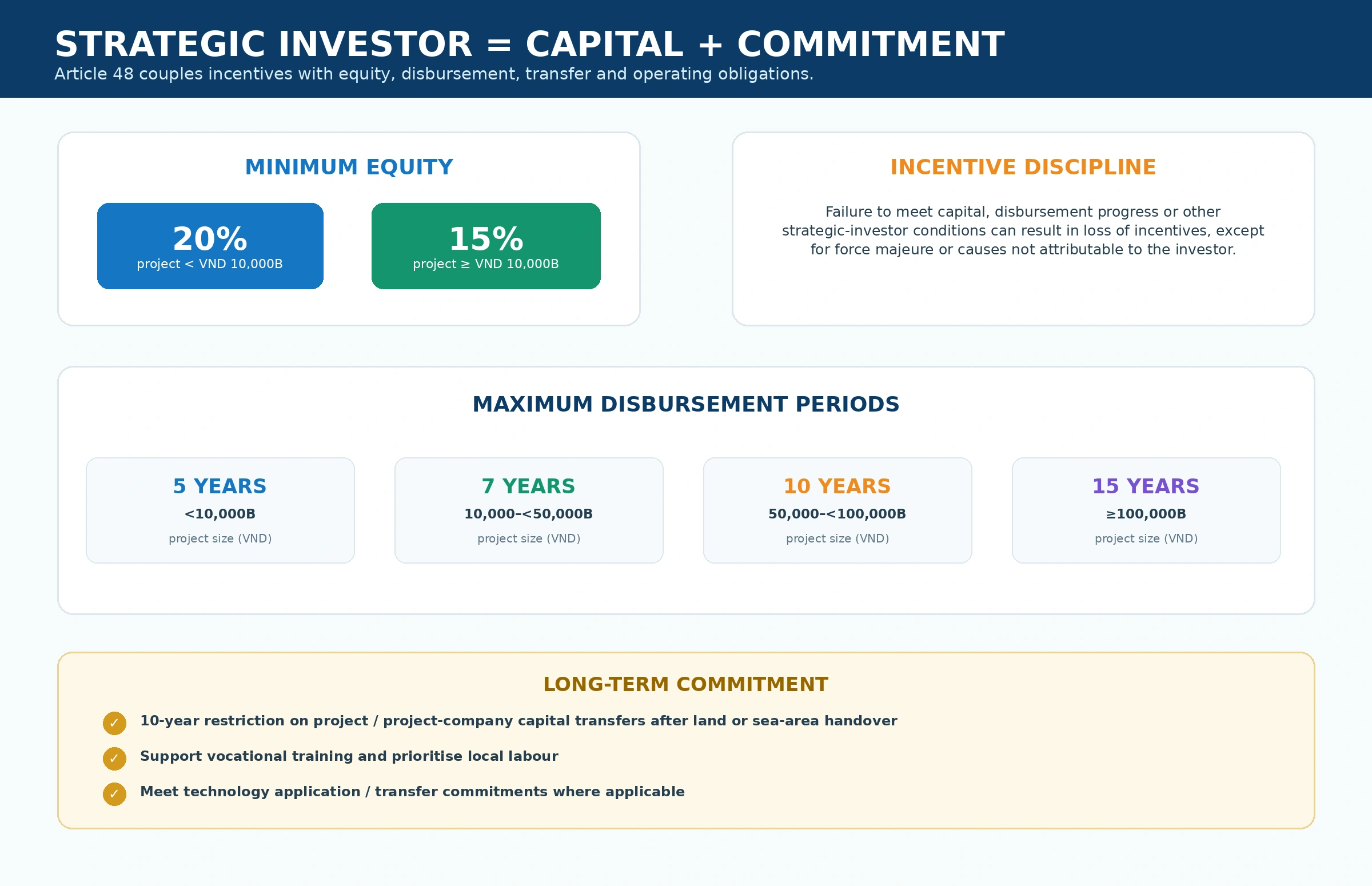
The law requires minimum project equity.
For projects below VND 10,000 billion, the strategic investor must contribute project equity equal to at least 20% of total investment.
For projects from VND 10,000 billion upward, the minimum is 15%.
Article 48 also contains specific consortium rules where multiple investors participate in the same project.
This is meaningful because project value alone can be misleading.
A VND 20,000 billion project supported by weak equity and uncertain execution capacity is not automatically more strategic than a smaller project backed by a specialised operator with a strong balance sheet and global network.
There is another signal in the law: strategic capital is expected to stay
Article 48 sets maximum periods for disbursing total project investment after the land or sea area is handed over in practice:
5 years for projects below VND 10,000 billion;
7 years for projects from VND 10,000 billion to below VND 50,000 billion;
10 years for projects from VND 50,000 billion to below VND 100,000 billion;
and 15 years for projects of VND 100,000 billion or more.
The law also restricts transfer of the project, or transfer of capital contributions / shares in the entity created to implement the project, for 10 years from the practical handover of land or sea area.
In addition, strategic investors have obligations relating to vocational training support for affected workers, priority recruitment of local labour, and technology application / transfer commitments where applicable.
If strategic-investor conditions concerning capital, disbursement progress or other requirements are not met, the investor can lose incentives under the law, subject to the stated exceptions for force majeure or causes not attributable to the investor.
The direction is clear:
preferential treatment is intended to be exchanged for real, long-term execution — not short-term control of an investment opportunity.
This matters particularly in Phu Quoc because the island already has a very large investment pipeline
As of June 2026, the Phu Quoc Economic Zone had 326 investment projects in force, covering more than 10,549 hectares, with total registered capital of approximately VND 508.660 trillion.
Investment disbursement during the first six months of 2026 reached approximately VND 31.603 trillion.
Official reporting also indicated that 58 projects were already operating, while others remained in various stages of implementation or investment procedures.
These numbers should not be read as proof of poor conversion: projects have different sizes, schedules and life cycles.
But they do demonstrate one thing very clearly.
Phu Quoc is not a place with no investment story.
The next question is the quality of capital conversion.
From projects to an economy: the anchor-investor effect
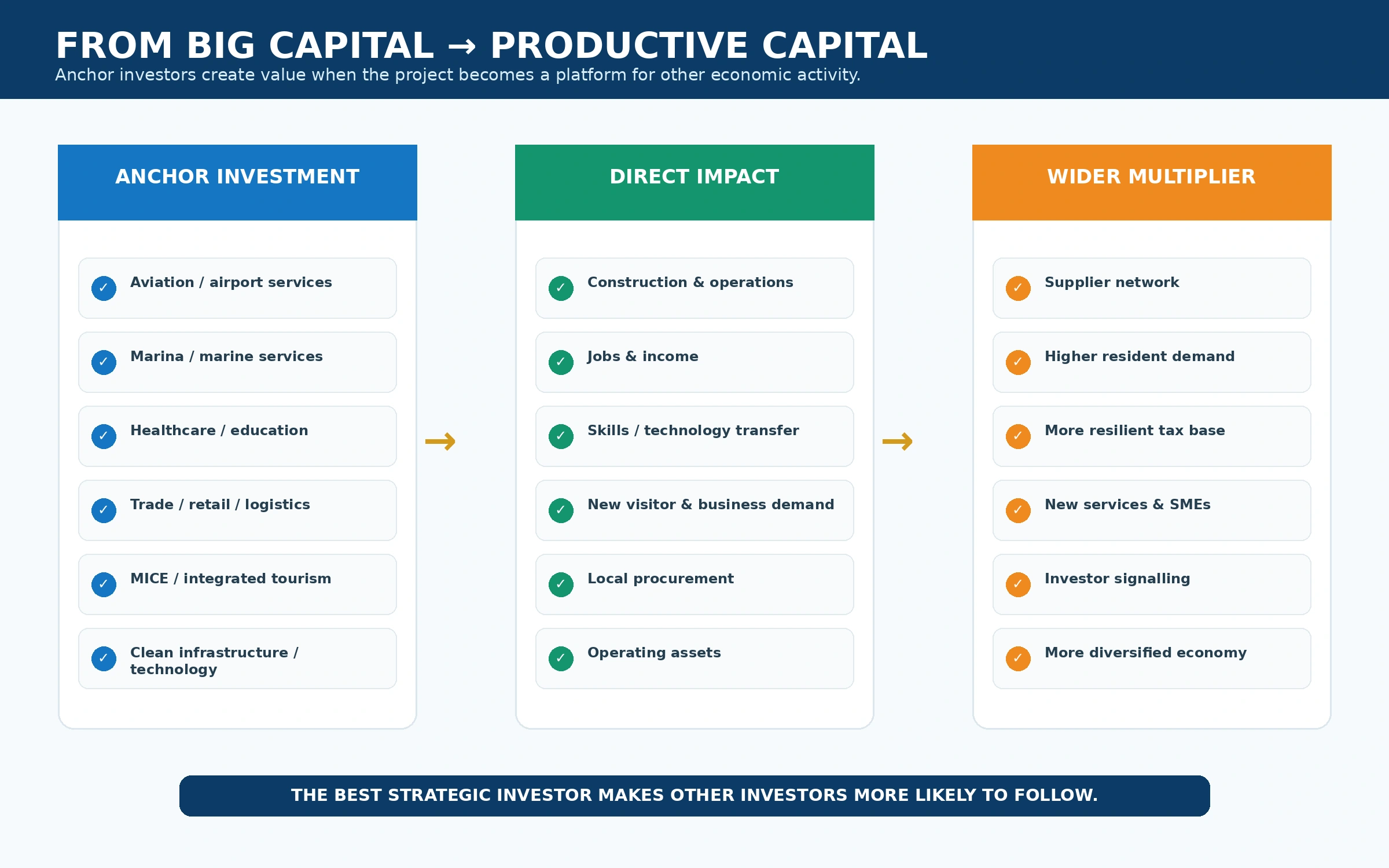
The World Bank’s anchor-investor concept is useful because it moves the analysis beyond project boundaries.
Imagine two projects.
Project A invests VND 20 trillion, builds an impressive physical asset and operates largely as a closed system.
It imports much of its expertise and procurement, creates few local suppliers, and generates limited demand outside its own boundary.
Project B invests VND 6 trillion but brings a recognised international operator, attracts partners, trains workers, buys from local suppliers, creates new visitor demand and gives other investors confidence to enter.
Project A is larger.
Project B may be more strategic.
This is what I mean by productive capital.
The six anchor-investor profiles I would prioritise for Phu Quoc
This is a PhuQuocHome analytical framework, not an official list.
It starts from Article 48 but filters the statutory categories through Phu Quoc’s actual economic structure.
1. Aviation Anchor
Phu Quoc is investing heavily in airport capacity ahead of APEC 2027. The next layer is not simply more terminal space. It is a stronger aviation ecosystem: international route development, aviation fuel, aircraft maintenance and technical services, ground services and selected cargo / business connectivity.
Article 48 explicitly recognises aviation infrastructure and, separately, aviation-fuel and aircraft maintenance / repair services among strategic-investor categories.
2. Marine & Marina Anchor
An island should generate more economic value from the sea than beach tourism alone.
A strong marina operator can support yacht charter, maintenance, crew services, F&B, luxury retail, insurance, marine tourism and related hospitality.
The objective should be an operating marine-services cluster — not simply a waterfront real-estate project.
3. Healthcare & Education Anchor
These projects can have an economic multiplier far beyond the land they occupy.
International-standard healthcare and education help retain professionals and their families, supporting long-stay housing, retail, transport, property management and recurring local consumption.
Article 48 sets a VND 1,000 billion threshold for qualifying high-quality healthcare and education projects.
4. Trade, Retail & Logistics Anchor
Phu Quoc already has international consumer traffic.
If non-tariff-zone and duty-free mechanisms eventually operate at scale, the island will need serious operators in travel retail, logistics, customs-facing systems, inventory, fulfilment, payments and brand distribution.
The wrong investor simply builds retail floor area.
The right investor creates sales per square metre.
5. Integrated Tourism & MICE Anchor
Phu Quoc already has substantial tourism investment.
Another large resort is strategic only if it creates something the island does not already have enough of: year-round events, international distribution, MICE demand, entertainment intellectual property, premium customers or longer stays.
The goal should be demand creation, not supply multiplication.
6. Clean Infrastructure & Technology Anchor
Every new hotel, residence or commercial project consumes capacity.
A utility or technology investor can expand capacity for the entire island.
Clean energy, storage, water technology, waste-to-resource, smart infrastructure and selected digital services can therefore create system-level value even when they generate less real-estate excitement.
What Article 48 is really testing
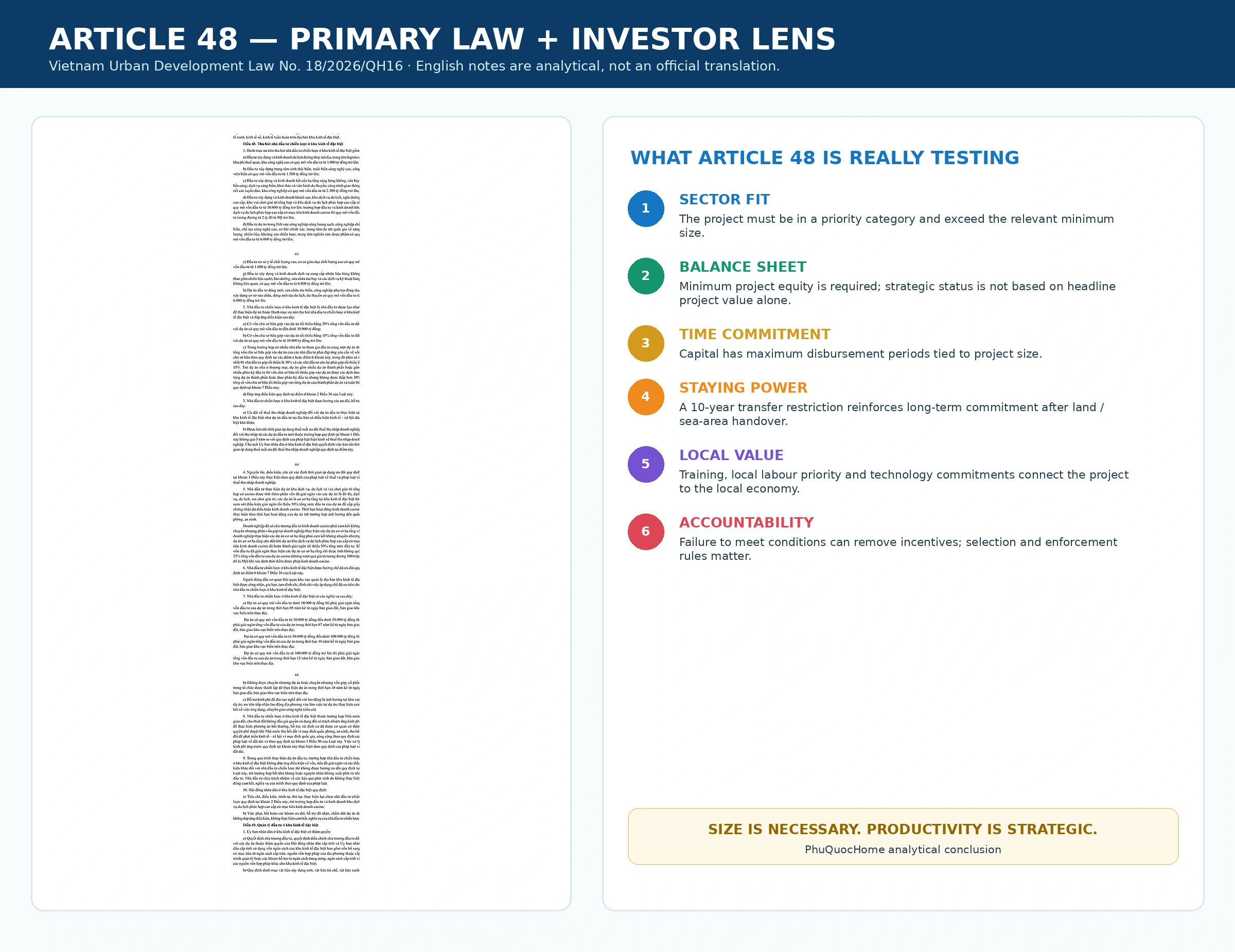
I read Article 48 as a six-part test.
Sector fit. Is the project in a priority category and above the statutory scale?
Balance sheet. Is there sufficient committed equity behind the project?
Time commitment. Can the investor disburse within the required period?
Staying power. Is the capital prepared to remain committed rather than exit early?
Local value. Will jobs, skills and technology link into the island economy?
Accountability. Are incentives conditional on actual delivery?
Those are much stronger questions than:
“How big is the project?”
Why Phu Quoc should be selective even when a project qualifies legally
Article 48 is a national legal framework for Special Economic Zones.
That does not mean every qualifying sector should receive equal strategic priority in Phu Quoc.
For example, the law includes shipbuilding and repair.
Phu Quoc may derive more value from yacht service, repair and marine tourism than from trying to become a large industrial shipbuilding centre.
The law also includes high-tech manufacturing categories.
But Phu Quoc must consider land scarcity, logistics, labour supply, environmental carrying capacity and competing industrial locations in Vietnam.
A good Special Economic Zone does not simply accept every project that qualifies. It knows which qualifying projects fit its own economic geography.
A strategic-investor scorecard for Phu Quoc
| Criterion | Investor question | Why it matters |
|---|---|---|
| Strategic fit | Does this project solve a missing economic capability? | Prevents capital from simply duplicating existing supply. |
| Execution capability | Has the investor built and operated comparable assets? | Reduces delivery and operating risk. |
| Network effect | Can the investor bring suppliers, customers, brands, routes or partners? | Creates an anchor effect beyond the project boundary. |
| Year-round demand | Does the project reduce seasonality? | Improves utilisation of island infrastructure. |
| Local multiplier | How much employment, procurement and spending stays locally? | Determines the depth of economic spillover. |
| Capital conversion | Will announced capital become operating assets on schedule? | Separates commitment from economic output. |
| Environmental fit | Is the project compatible with island carrying capacity? | Protects the natural assets that support the economy itself. |
UNCTAD adds another important requirement: local linkages
UNCTAD has repeatedly emphasised that the wider developmental value of an SEZ depends on linkages between the zone and the domestic economy.
Technology, skills, employment and supplier opportunities need to spill beyond the investment enclave.
This is particularly important for Phu Quoc.
If an international investor enters but imports most labour, supplies and services, the headline capital figure can be large while the local multiplier remains limited.
If the investor helps create local suppliers, skills, management capability and new resident demand, the same project becomes much more valuable to the island.
APEC 2027 changes the strategic-investor question
Phu Quoc is currently implementing 21 APEC-related projects with combined investment above VND 137.138 trillion.
This is a major hardware build-out.
After the infrastructure exists, the strategic question changes.
Who will operate the economic software on top of the new hardware?
Who creates international routes?
Who fills convention capacity?
Who turns visitor traffic into higher-value spending?
Who creates a long-stay professional population?
Who develops marine services?
Who expands the island’s utility and environmental capacity?
Those are strategic-investor questions.
Tax incentives should not become the investment thesis
Article 48 provides corporate-income-tax incentives for qualifying strategic-investor projects and allows an extension of the preferential tax-rate period within the conditions stated by the law.
The tax policy specified at point (a), Clause 3 of Article 48 applies from the 2027 tax period under the Law’s implementation provisions.
But an investor should not come to Phu Quoc solely because tax is lower.
Tax can improve a good project.
It cannot rescue a project with:
weak demand;
poor execution;
the wrong location;
the wrong operator;
or an unsustainable relationship with the island’s physical capacity.
Conclusion: the best strategic investor makes the next investor more likely to come
This is where the anchor-investor concept becomes most useful.
A credible operator arrives.
Suppliers follow.
Partners follow.
Talent follows.
Customers follow.
Other capital becomes more confident.
That is a network effect.
Article 48 gives Vietnam a legal structure for defining strategic investors through sector, scale, equity, incentives and obligations.
But the economic value of that framework will ultimately depend on selection.
For Phu Quoc, the goal should not be to attract the largest possible investment number. It should be to attract capital that unlocks the largest amount of productive economic activity around it.
That is the difference between a large project and a strategic investor.
Primary legal source: Article 48, Vietnam Urban Development Law No. 18/2026/QH16. The article defines priority strategic-investor project categories, minimum project scales, equity requirements, incentives, disbursement periods, transfer restrictions and investor obligations. English wording in this research is analytical guidance, not an official legal translation.
Tax timing: Article 63 states that the tax incentive at point (a), Clause 3 of Article 48 applies from the 2027 tax period.
Phu Quoc investment: Phu Quoc Economic Zone Authority reported 326 projects in force, approximately VND 508.660 trillion registered capital, VND 31.603 trillion disbursed in H1 2026 and 58 projects operating: official source.
APEC 2027: official Phu Quoc reporting identifies 21 APEC-related projects with total investment above VND 137.138 trillion: official source.
Anchor investors: World Bank SEZ guidance notes that targeted anchor-investor strategies can be highly effective; anchor investors can signal credibility and bring supplier and partner networks: World Bank.
Local linkages: UNCTAD highlights the importance of backward linkages, domestic suppliers, skills and technology spillovers rather than treating SEZs as isolated enclaves: UNCTAD.
“Productive Capital”, the six Phu Quoc anchor profiles and the strategic-investor scorecard are PhuQuocHome analytical frameworks, not official selection criteria.